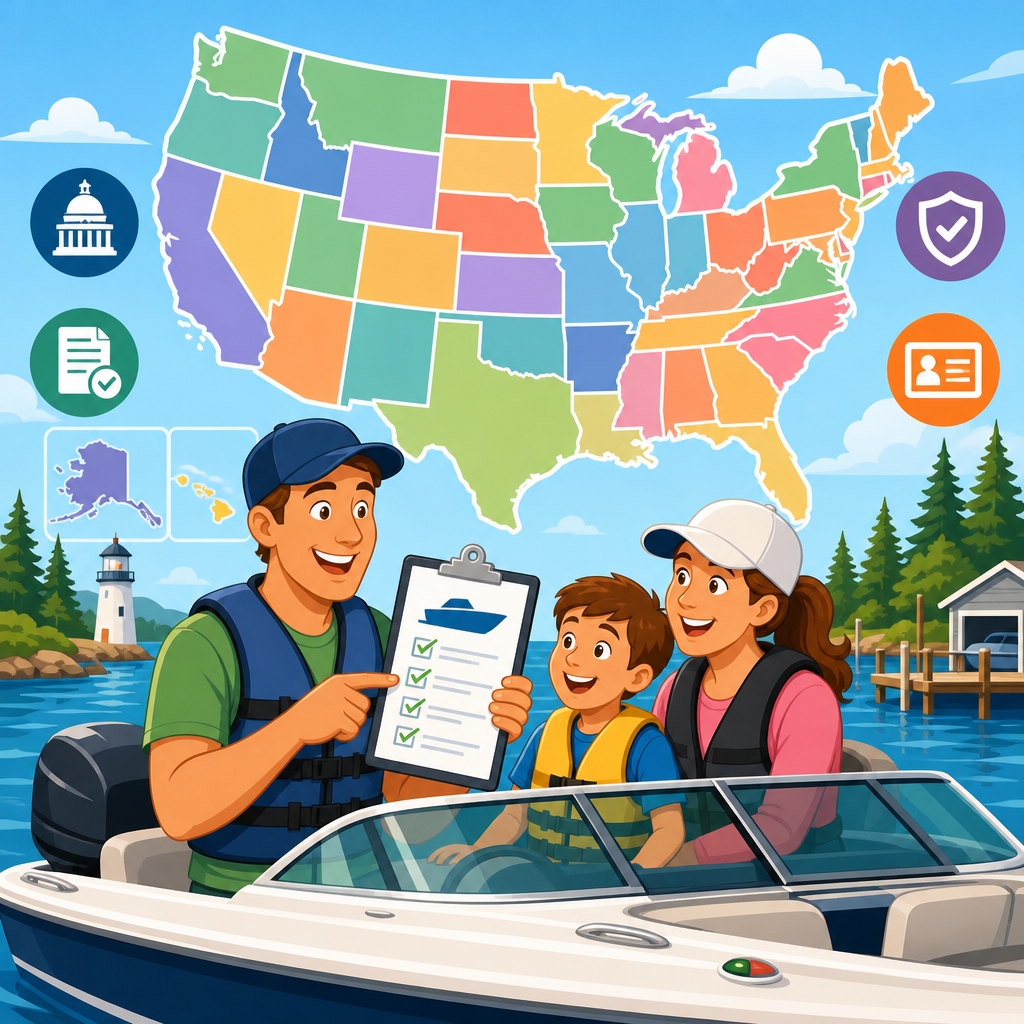
Boat registration requirements by state can confuse first-time buyers, private sellers, and even experienced owners because registration, titling, and tax rules are set largely at the state level, not by one national system. In practice, that means a fishing boat bought in Florida, a pontoon moved to Michigan, and a sailboat documented with the U.S. Coast Guard can all follow different paperwork paths. If you are buying or selling a boat, understanding boat titles, registration, and taxes is essential because small errors can delay use, trigger penalties, or complicate a later resale.
Boat registration is the state process that assigns a vessel number and issues decals or certificates proving the boat is legally registered for operation on public waters. A boat title is the ownership document, similar to a car title, used by states that title certain vessels to show legal ownership and record liens. Boat taxes usually include sales tax, use tax, local surtax, and sometimes annual personal property tax or registration fees. These terms overlap, but they are not interchangeable. A boat can be registered without being titled in some jurisdictions, titled without federal documentation in others, and taxed based on where it is principally used rather than where it was purchased.
I have worked with buyers closing private-party deals, marine lenders perfecting liens, and owners transferring boats across state lines, and the same pattern repeats: people assume the bill of sale is enough. It rarely is. States may require a signed title, hull identification number verification, proof that sales or use tax was paid, an application within a strict deadline, and supporting documents for trailers or outboard motors. Missing just one item can send you back to the seller, the tax office, or a marina hundreds of miles away. That is why this topic matters not only for compliance, but also for protecting value and proving clean ownership when you eventually sell.
This hub article explains how state boat registration requirements generally work, where titles fit, when taxes apply, and which exceptions create the most confusion. It is designed to help you ask the right questions before money changes hands: Does the boat need a state title, federal documentation, or both? Which agency handles registration? What documents transfer ownership? When is tax due, and can tax paid in another state offset your bill? Answering those questions early reduces risk, speeds up closing, and makes every related step in buying and selling boats easier.
How Boat Registration Works Across States
Most states require mechanically propelled boats operated on public waters to be registered through a department of natural resources, wildlife agency, state parks office, or motor vehicle department. Registration usually results in a certificate of number and validation decals that must be displayed according to state rules. The federal baseline comes from the U.S. Coast Guard numbering framework in 33 CFR, but each state implements it differently, especially for exemptions, fees, deadlines, and titling thresholds. Human-powered craft, some sailboats under a certain length, and boats used only on private ponds are often exempt, but the exact wording varies widely.
For example, Florida generally requires registration for vessels operated, used, or stored in the state, while Texas requires most motorized vessels and many sailboats to be titled and registered through Texas Parks and Wildlife. In Michigan, the Secretary of State handles watercraft registration, and the validity period and decal placement differ from neighboring states. California registers boats through the Department of Motor Vehicles, creating a process more familiar to car owners, while states such as Minnesota rely on natural resource agencies. The practical takeaway is simple: owners should verify requirements with the agency in the state where the boat will be principally used, not just where the sale occurred.
Timing matters. Many states impose a deadline of roughly 15 to 60 days after purchase or entry into the state to apply for registration or title transfer. During that window, officers may accept a temporary document package, but only if it includes a properly assigned title or registration proof. I routinely tell buyers to build a closing file before pickup day: signed bill of sale, previous registration, title if issued, lien release, HIN photos, and government ID copies. That file solves most registration delays because state clerks are not guessing what happened; they can see a clean chain of ownership.
Titles, Federal Documentation, and Proof of Ownership
A boat title is the strongest state-level proof of ownership when a state issues one for that vessel type. States differ on which boats are titleable. Some title all motorized boats, some only title boats over a certain length or model year, and some exclude small craft or older vessels. If a state does not title a vessel, the transferable registration card plus bill of sale may serve as ownership evidence. That distinction matters in private sales. A buyer who pays for a boat that should have a title but receives only a handwritten receipt may face a bonded title process, enforcement concerns, or litigation with prior owners and lienholders.
Federal documentation is separate from state titling. Eligible vessels measuring at least five net tons, which many boats over roughly 25 feet meet, may be documented with the National Vessel Documentation Center under the U.S. Coast Guard. Documentation establishes a national ownership record and is often required by marine lenders for larger boats because preferred ship mortgages attach to documented vessels. However, federal documentation does not usually eliminate state obligations. Many states still require documented boats to register for state use decals and still assess sales or use tax. Owners often misunderstand this and assume the federal certificate replaces all local paperwork. It does not.
Proof of ownership should create an unbroken chain. In the cleanest transaction, the seller produces the current title or documentation abstract, satisfies any lien, signs the transfer exactly as required, and provides a bill of sale listing the HIN, make, year, purchase price, and sale date. If an outboard motor or trailer is included, those assets may require separate serial numbers and titles. I have seen otherwise valid boat deals stall because the trailer title remained in a deceased relative’s name or the bank lien on the boat had been paid off but never formally released. Ownership problems are easier to fix before funds are released than after the boat is in your driveway.
Common State-by-State Differences Buyers and Sellers Must Check
The core question behind boat registration requirements by state is not whether rules differ, but how. Buyers and sellers should confirm the state agency, whether title and registration are both required, filing deadlines, accepted proof of ownership, tax rules, HIN inspection requirements, and exemptions for documented boats, tenders, canoes, kayaks, or electric-only craft. In cross-state deals, the destination state controls most next-step compliance, while the origin state controls how current ownership is transferred. That split is why out-of-state purchases deserve extra diligence.
| Issue to Check | Why It Matters | Example of State Variation |
|---|---|---|
| Title requirement | Determines whether a bill of sale alone is sufficient | One state titles most motorboats; another may exempt older or smaller vessels |
| Registration deadline | Late filing can trigger penalties or operating limits | Some states allow about 15 days after purchase, others 30 or more |
| Documented vessel rules | Federal papers may not replace state decals | Many states still require annual or multi-year state registration |
| Tax calculation | Affects total closing cost and future audit risk | States may apply sales tax, use tax credits, caps, or local surtaxes |
| Trailer and motor paperwork | Separate assets often need separate transfer documents | Trailer title may go through the motor vehicle agency, not the boating office |
Consider a real-world scenario: a buyer in North Carolina purchases a used center console in Georgia. Georgia may not title that exact vessel depending on length and propulsion history, but North Carolina may still require specific ownership evidence for registration and tax purposes. If the seller provides only an old registration card without a complete bill of sale or HIN confirmation, the buyer may have trouble proving lawful transfer. Similar problems arise when a documented yacht from New York is moved to South Carolina and the owner fails to obtain state registration decals within the required period. The boat is legal under one system but noncompliant under another.
Another frequent point of confusion is residency. Snowbirds, military families, and owners with boats in dry storage often ask which state controls registration. The answer usually depends on where the boat is principally used or stored, how long it remains in the state, and whether the owner is considered a resident there. States write these rules differently and enforce them differently. Marinas, lenders, and insurers usually expect the paperwork to align with the vessel’s real location. If registration, insurance address, and tax declarations point to different states, expect extra questions.
Boat Sales Tax, Use Tax, and Other Costs
Taxes are where many boat deals become more expensive than buyers expect. A state sales tax generally applies when a dealer sells a boat in-state, while a use tax often applies when a boat is bought elsewhere but brought into the state for use, storage, or docking. In principle, use tax prevents buyers from avoiding tax by shopping across borders. Most states allow a credit for legally paid tax to another state, but not always for every local add-on. That means a buyer can still owe a difference if the home state rate is higher or if local surtaxes apply.
For example, if you buy a boat in a state with a lower tax rate and bring it to a state with a higher use tax, the destination state may credit the tax already paid and bill you for the remainder. Some states cap tax on vessels above a certain amount, while others do not. A few localities also assess annual personal property tax based on assessed value. Registration fees themselves may be flat, length-based, horsepower-based, or staggered by residency. These costs should be calculated before closing, especially on larger yachts where a few percentage points can mean thousands of dollars.
Documentation is critical for tax compliance. Keep the purchase agreement, bill of sale, proof of tax paid, wire confirmation, and any broker closing statement. If you claim an exemption, such as a casual sale exclusion, interstate commerce exception, or resale purchase by a dealer, retain the statute-based form and supporting evidence. Tax agencies can audit boat purchases years later because vessels are visible assets with marina records, insurance records, and Coast Guard documentation trails. In my experience, owners who maintain a complete closing binder answer tax questions quickly; owners who rely on memory usually end up reconstructing the deal at the worst possible time.
How to Complete a Clean Transfer When Buying or Selling
A clean transfer starts before the listing goes live. Sellers should locate the title or registration, verify the exact owner name, confirm whether any lien remains, and photograph the hull identification number. Buyers should compare the HIN on the transom and paperwork, check for alterations, and make sure the seller’s identification matches the ownership documents. If a broker is involved, the closing package should clearly separate the boat, outboard motor, trailer, accessories, and deposit handling. Ambiguity creates disputes later, particularly when state agencies want serial-specific transfer evidence.
At closing, the safest practice is to sign every transfer field exactly as the issuing authority requires. Do not abbreviate names if the title uses full legal names. Do not erase mistakes; request a replacement title if necessary. Include the purchase price, sale date, and HIN on the bill of sale, and obtain a lien release on lender letterhead if the title shows a secured party. For documented vessels, request a Coast Guard abstract of title before funds are released, because it reveals recorded ownership and mortgages. That step is standard in larger transactions and should not be skipped.
After the sale, file immediately. Buyers should submit title and registration applications, tax forms, and supporting documents before operating the vessel regularly. Sellers should notify the state or documentation authority that ownership has transferred, remove old registration decals if required, and keep copies of the signed transfer package. Those copies protect against tolls, abandoned vessel claims, and accidents involving the boat after it leaves your possession. The main benefit of doing this right is not just legal compliance. It preserves resale value, keeps financing and insurance straightforward, and gives both parties confidence that the vessel’s ownership history will stand up to scrutiny.
Conclusion
Boat registration requirements by state shape every stage of ownership, from the first bill of sale to the day you list the boat for resale. Registration proves legal operation, titling proves ownership where required, and tax compliance proves the transaction was properly reported. Because states handle these rules differently, the right approach is to verify the destination state’s agency, deadlines, title standards, exemptions, and tax treatment before you buy, sell, move, or store a vessel. That is especially important for out-of-state deals, federally documented boats, and transactions involving trailers, lenders, or inherited property.
The most reliable process is also the simplest: confirm the HIN, collect a complete chain of ownership, resolve liens before closing, document the purchase price accurately, and file title, registration, and tax paperwork on time. When owners treat the paperwork with the same care they give a survey or sea trial, they avoid the most common and costly mistakes. Use this guide as your starting point, then review your state boating agency’s forms and requirements before the transaction begins so your next boat purchase or sale closes cleanly and confidently.
Frequently Asked Questions
Do all boats need to be registered, or are there exemptions depending on the state?
Not every boat must be registered in every situation, but most motorized boats are required to be registered in the state where they are primarily used. That said, exemptions vary widely by state. In many places, small non-motorized craft such as canoes, kayaks, rowboats, paddleboards, and some inflatables may be exempt from registration unless they have a motor attached. Some states also create special exemptions for boats used only on private property, boats owned by government agencies, lifeboats, racing shells, or vessels that are already federally documented with the U.S. Coast Guard. Even when a boat is exempt from registration, it may still be subject to other requirements such as local lake permits, invasive species decals, launch permits, or proof of ownership rules.
Because state laws differ, the most important step is to check the boating agency in the state where the boat will be principally operated, not just where it was purchased. A boat that does not need registration in one state may require it immediately after being moved to another. This is especially common when owners relocate, keep a boat seasonally in a different state, or buy from a private seller across state lines. Before assuming an exemption applies, verify the vessel type, length, propulsion, and intended use under the current state rules.
What documents are usually required to register a boat after buying it?
In most states, boat registration starts with proving ownership and providing basic vessel information. Buyers are commonly asked to submit a signed bill of sale, the previous registration, the title if the state titles that class of boat, and a completed application for registration or title. If the boat was purchased from a dealer, the dealer may provide a purchase agreement, manufacturer’s certificate or statement of origin, and tax paperwork. If the purchase was from a private seller, states usually expect signatures from both parties, the date of sale, the purchase price, and clear hull identification number information. Some states also ask for the trailer paperwork separately, since boat trailers often have their own title and registration process.
If the vessel is coming from another state, expect closer review. The agency may compare the hull identification number, prior state documents, lien information, and whether that state issued a title or only a registration. If the boat is U.S. Coast Guard documented, some states require a copy of the federal documentation instead of a state title, while others may still require state registration for operating on local waters. Missing paperwork can cause delays, especially when a seller never transferred title correctly or there is an unreleased lien. For that reason, buyers should review the chain of ownership before paying and make sure names, vessel numbers, and signatures match exactly across all documents.
What is the difference between boat registration and a boat title, and does every state require both?
Registration and title are related, but they serve different legal purposes. Boat registration is generally the state’s record allowing the vessel to be operated lawfully on public waters, similar to a vehicle registration. It usually results in registration numbers and decals that must be displayed on the boat. A title, by contrast, is the ownership document that helps establish legal ownership and records liens. Not all states title every boat, and some title only certain vessels based on length, age, propulsion type, or model year. As a result, one state may issue both a title and registration for a powerboat, while another may issue only registration for a similar vessel.
This distinction matters a great deal during a sale. If a state requires titles for that type of boat, the title must usually be properly assigned from seller to buyer before the registration can be transferred. If the boat comes from a non-title state into a title state, the new state may ask for alternate ownership proof such as a notarized bill of sale, old registration certificates, or an affidavit. Federally documented vessels add another layer because federal documentation functions as a national ownership and nationality record, but state-level registration and tax obligations may still apply. In short, buyers and sellers should never assume the rules are identical across state lines, because title requirements are one of the most common points of confusion.
How do sales tax, use tax, and out-of-state boat purchases affect registration?
Taxes are often where boat buyers get surprised. In many states, a buyer cannot complete registration until applicable sales tax or use tax has been paid or documented as exempt. If you buy from a dealer, the dealer may collect the tax at the time of sale. If you buy from a private seller, the state may assess tax when you apply for registration based on the purchase price, fair market value, or other rules set by state law. Some states are stricter than others about low sale prices listed on bills of sale, especially if the price appears far below market value. In those cases, the agency may request additional proof or calculate tax differently.
Out-of-state purchases can be even more complicated. You may owe tax in the state where the boat will be principally used, even if you bought it elsewhere. Some states offer credits for tax legally paid to another state, but the rules and limits vary. There may also be deadlines for bringing the boat into the state and applying for registration. Missing those deadlines can lead to penalties, interest, or late fees. Exemptions can exist for gifts, inheritances, transfers between certain family members, or boats used in qualifying commercial operations, but exemptions typically require documentation. The safest approach is to confirm tax treatment before purchase so you understand the true total cost of ownership and can avoid problems when filing for registration.
What should buyers and sellers do to avoid boat registration problems during a private sale?
The best protection in a private boat sale is careful documentation before money changes hands. Sellers should gather the current title if one exists, the latest registration, lien release documents if applicable, service records, and a clear bill of sale form that includes the boat’s make, model, year, hull identification number, registration number, sale price, and date of transfer. Buyers should compare all identifying numbers on the paperwork to the boat itself and confirm that the seller’s name matches the ownership documents exactly. If a title exists, the buyer should make sure it is assigned properly and signed in the right places, because even small errors can delay or block registration in some states.
It is also smart to confirm state-specific transfer deadlines immediately after the sale. Many states require a buyer to apply for transfer or registration within a set number of days, and some require the seller to notify the state that the vessel has been sold. That seller notice can be important because it helps limit future liability tied to the boat. Buyers should also ask whether the boat is subject to state titling, whether the trailer is included, whether taxes will be due at registration, and whether any federal documentation affects the transfer. When both parties handle the paperwork carefully and verify the receiving state’s rules in advance, the transaction is far less likely to turn into a title dispute, tax issue, or rejected registration application.