Solar-powered boat accessories have moved from niche upgrades to core equipment for cruisers, anglers, liveaboards, and weekend boaters who want quieter systems, lower fuel use, and more reliable power away from shore. In 2025, the best options are no longer limited to a single panel on a cabin roof. They include charging systems, ventilation, lighting, monitoring tools, refrigeration support, security devices, and portable backup gear designed specifically for wet, corrosive marine environments. For boat owners building an eco-friendly boating gear setup, solar accessories matter because they reduce dependence on engine alternators, cut generator runtime, and make basic onboard comforts easier to sustain.
When I evaluate marine solar gear, I look at three things first: actual energy yield, installation durability, and system compatibility. A lightweight panel that produces poor output in partial shade is not a bargain. A clever accessory that lacks proper ingress protection or marine-grade wiring will fail early. And a high-end charger that cannot communicate with your battery chemistry, whether flooded lead-acid, AGM, gel, or LiFePO4, becomes an expensive mismatch. The best solar-powered boat accessories for 2025 solve real onboard problems with measurable gains in efficiency, safety, or convenience.
This guide covers the strongest categories in eco-friendly boating gear and explains which accessories deliver the most value. It also serves as a hub for broader sustainable boating decisions, including clean power management, efficient lighting, low-draw appliances, and monitoring systems that prevent waste. If your goal is to anchor longer, preserve battery life, or reduce the environmental footprint of daily boating, the accessories below are the practical starting point. They are useful on sailboats, pontoons, trawlers, center consoles, and small cruisers alike, provided the system is sized correctly.
Before buying, define a few key terms. Wattage describes how much power a panel can generate under standard test conditions. Amp-hours measure battery storage capacity. A charge controller regulates panel output so batteries charge safely. MPPT controllers generally outperform PWM units by converting excess panel voltage into usable current, especially when panel voltage is substantially higher than battery voltage. Marine-grade means the component is designed for vibration, salt exposure, UV, and moisture. Those distinctions matter because marine solar systems fail less from the concept than from poor component selection.
Solar panels and charge controllers that form the foundation
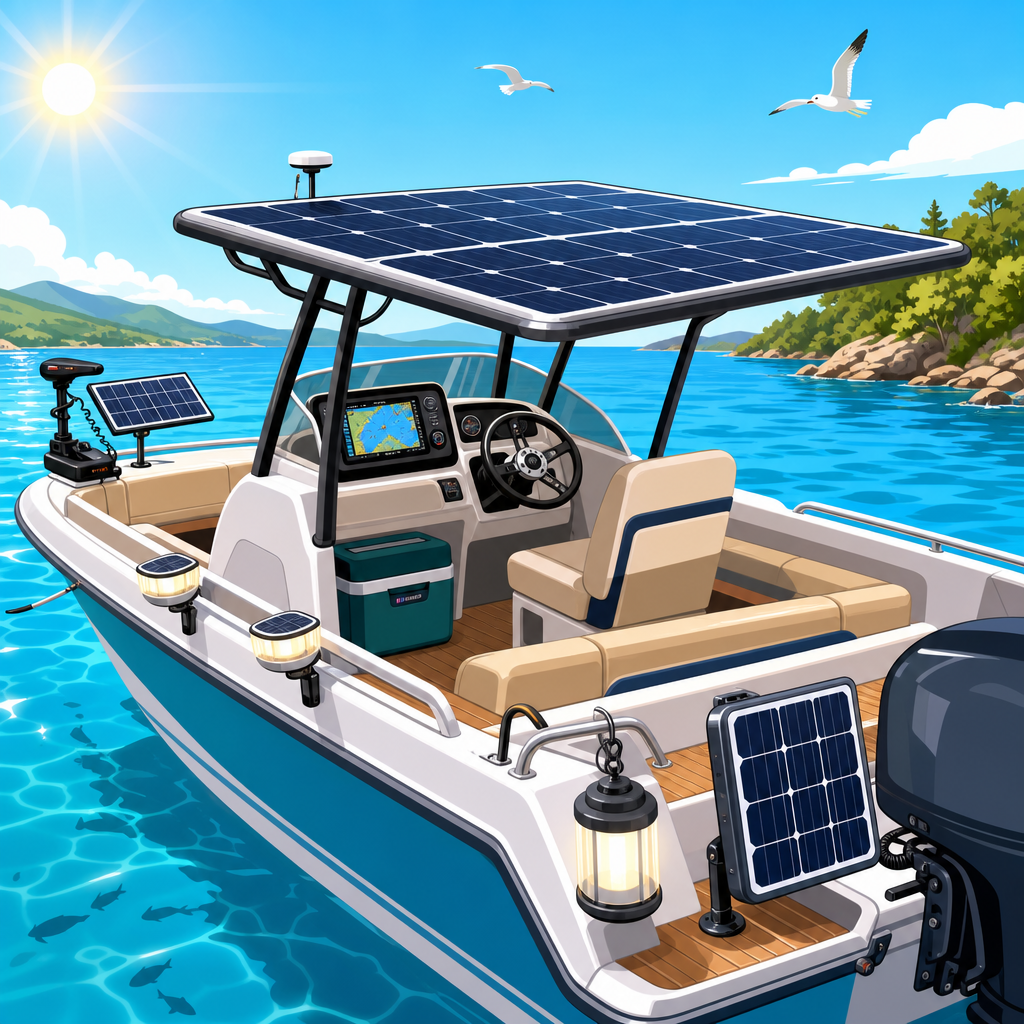
The most important solar-powered boat accessory is still the panel-and-controller pair, because every other accessory depends on reliable charging. In 2025, monocrystalline panels remain the best all-around choice for marine use due to higher efficiency and stronger low-light performance than older polycrystalline designs. Rigid panels are ideal on hardtops, radar arches, and cabin tops where airflow helps cooling. Semi-flexible panels fit curved surfaces and low-profile installations, but they usually run hotter and may have shorter service life unless you choose premium models with ETFE surfaces and quality backing materials.
In practical use, I have seen many boaters under-panel their boats. A 50-watt panel may maintain a mooring battery bank with light loads, but it will not meaningfully support refrigeration, fans, electronics, and lighting. For coastal cruising, 200 to 400 watts is a common minimum for small to midsize boats that want to offset daily hotel loads. BlueSolar and SmartSolar MPPT lines from Victron Energy, as well as controllers from Renogy and Morningstar, are widely used because they provide stable charging profiles and, in many models, app-based monitoring that makes troubleshooting straightforward.
Choose a controller with temperature compensation for lead-acid batteries and configurable charging parameters for lithium systems. If a panel is shaded regularly by antennas, outriggers, or a boom, consider wiring layouts that reduce mismatch losses or use multiple smaller panels instead of one large module. Also prioritize tinned copper wire, proper gland seals, and correctly sized fuses or breakers. A solar setup is only as good as its installation details, and corrosion at one connection can erase the benefit of premium hardware.
Best solar-powered accessories by use case in 2025
Once charging capacity is in place, the best accessories are the ones that lower draw or use solar directly for a dedicated task. That is where eco-friendly boating gear becomes more than a marketing phrase. The products below stand out because they either improve onboard efficiency or perform a useful function without tapping the main battery bank continuously.
| Accessory | Best use | Why it matters in 2025 |
|---|---|---|
| Solar vent fans | Cabin ventilation at anchor or on the trailer | Reduce mold, heat buildup, and passive battery drain |
| Solar anchor lights | Small boats, dinghies, mooring setups | Independent lighting improves safety without house-bank use |
| Portable solar chargers | Kayaks, tenders, backup charging | Useful for phones, handheld VHF, USB lighting, and emergency devices |
| Solar battery maintainers | Stored boats and seasonal use | Help prevent sulfation and dead starting batteries |
| Solar security cameras or sensors | Marina slips and remote moorings | Add low-maintenance monitoring without hardwiring complexity |
| Solar pathway or courtesy lights | Docks, swim platforms, boarding areas | Improve nighttime access with no added circuit load |
Solar vent fans are among the highest-value upgrades because moisture control is a constant marine problem. A compact vent from brands such as Nicro can keep air moving through a closed cabin, reducing condensation, stale odor, and mildew growth. They work especially well on trailer boats, pocket cruisers, and sailboats left closed up between outings. Their limitation is airflow volume; they support background ventilation, not full cabin cooling. Even so, they are one of the simplest ways to improve comfort while lowering the need for battery-powered fans.
Solar anchor lights and courtesy lights are another strong category, especially for small boats where every amp-hour matters. A self-contained all-round light mounted on a dinghy, skiff, or mooring buoy can maintain legal visibility without wiring into the main system. For larger vessels, these lights are better treated as supplemental rather than primary navigation lighting unless they meet the required standards and visibility ranges for your jurisdiction. The key benefit is independence: if the house bank is low, critical exterior visibility can remain available.
Portable foldable panels have become more useful in 2025 because USB-C Power Delivery and regulated 12-volt outputs are now common. A quality portable charger can keep handheld electronics running in a tender, on a paddleboard, or during an overnight anchorage where your main array is shaded. Look for laminated, weather-resistant units from established outdoor power brands and verify whether the stated wattage reflects realistic field performance. In my experience, portability is valuable, but rigid mounting still wins for consistent daily production.
Energy efficiency accessories that make solar work better
The smartest eco-friendly boating gear strategy is not simply adding generation. It is reducing demand so the solar system you already own performs better. LED lighting is the clearest example. Replacing halogen or incandescent cabin bulbs with warm-white marine LEDs can cut lighting consumption by 70 to 90 percent while reducing heat. Navigation and spreader lights also benefit, though compatibility with existing fixtures and radio-frequency interference should be checked before purchase. Reputable marine LEDs from Hella marine, Lumitec, and Aqua Signal are worth the premium because output, sealing, and color consistency are better.
Battery monitors are equally important. A Victron SmartShunt or BMV monitor gives real visibility into amp-hours consumed, state of charge, voltage trends, and charging current. Without that data, many owners misdiagnose system performance and either overspend on panels or overdischarge batteries. On boats using lithium, battery management system integration is especially useful because charging acceptance, low-temperature cutoffs, and alternator interactions all affect overall performance. Monitoring is not glamorous, but it is one of the best upgrades for anyone serious about sustainable power use.
Efficient DC refrigeration support is another major category. Very few boaters run a refrigerator directly from a dedicated solar accessory, yet solar capacity often determines whether refrigeration is practical at anchor. Modern compressor fridges from Dometic, Isotherm, and Vitrifrigo draw far less than older thermo-electric coolers or poorly insulated legacy units. Pairing better insulation, a properly set thermostat, and adequate ventilation around the compressor can dramatically lower daily energy use. In real cruising setups, these changes often produce more usable endurance than adding one more small panel.
Do not overlook inverters and DC-DC chargers. A low-quality inverter wastes energy through conversion losses and idle draw, undermining the value of your solar array. If you must run AC devices, use a pure sine wave inverter sized to your real load, not a vastly oversized unit that idles inefficiently. For boats charging from outboards or tow vehicles, a modern DC-DC charger can safely optimize input to a house battery bank and complement solar charging rather than conflict with it.
How to choose the right solar accessories for your boat
Start with your energy profile. List every daily load: chartplotter, fishfinder, autopilot, cabin lights, freshwater pump, refrigeration, stereo, internet gear, fans, and phone charging. Estimate total amp-hours used over twenty-four hours. Then compare that figure with realistic solar production, not nameplate optimism. In summer, a 200-watt array may produce roughly 50 to 70 amp-hours per day into a 12-volt system under favorable conditions, but shading, heat, and panel angle can reduce that. Once you know the numbers, accessory choices become much clearer.
Next, match the product to your boating pattern. A marina-based day boat may benefit most from a simple maintainer, solar vent, and efficient LEDs. A trailerable fishing boat needs corrosion resistance, quick disconnects, and compact panels that survive highway vibration. An anchoring sailboat may prioritize MPPT charging, battery monitoring, and refrigeration efficiency over novelty gadgets. Pontoon owners often get excellent value from solar courtesy lighting and portable charging stations because open deck layouts make small upgrades easy to install and useful for entertaining.
Mounting location is often the deciding factor. Hardtops provide the cleanest rigid-panel installation. Bimini tops can work, but fabric flex, shading, and fastener durability require careful design. Rail mounts are useful for stern arrays on sailboats, though they add windage and can be shadowed by davits or antennas. If space is limited, buy the most efficient panel you can justify rather than filling the surface with low-output modules. Higher efficiency usually means fewer compromises in placement.
Finally, vet claims carefully. Marine accessory marketing often overstates runtime and understates installation complexity. Check ingress protection ratings, warranty terms, controller specifications, and whether the product includes marine-grade connectors or just generic hardware. Look for ABYC-aligned installation practices, proper overcurrent protection, and batteries charged according to manufacturer specifications. The best systems are boring in the right way: they work daily, quietly, and predictably.
Building an eco-friendly boating gear hub beyond solar
Solar-powered accessories are the center of sustainable onboard power, but they work best as part of a broader eco-friendly boating gear plan. That plan includes non-toxic cleaners that protect waterways, reusable galley storage that reduces plastic waste, efficient bilge management, low-flow washdown habits, and propulsion choices that fit actual use. Electric outboards, shore-power chargers with proper profiles, and high-efficiency appliances all connect back to the same principle: consume less, waste less, and design for reliability.
As a hub topic, solar should also lead boaters into adjacent questions. How do you size batteries for weekend cruising? When is lithium worth the cost over AGM? Which marine fans deliver the best airflow per amp? What makes a charger safe for dual-bank systems? Those are not separate from solar; they are the decisions that determine whether a solar investment performs as promised. The strongest eco-friendly setups come from treating energy generation, storage, and consumption as one system rather than shopping accessory by accessory.
For 2025, the best solar-powered boat accessories are the ones that solve frequent onboard problems with minimal maintenance. Start with quality monocrystalline panels and an MPPT controller, then add high-value upgrades such as solar vent fans, battery monitors, LED lighting, portable charging panels, and battery maintainers. If you boat at anchor often, prioritize refrigeration efficiency and accurate energy tracking. If your boat sits unused for stretches, focus on maintenance charging and ventilation. The right mix depends on how you use the boat, but the principle is constant: reduce electrical waste first, then generate clean power reliably.
Done well, solar makes boating simpler as much as greener. Engines run less, batteries last longer, cabins stay drier, and basic comforts remain available without constant charging anxiety. Use this guide as your starting hub for eco-friendly boating gear, review your current loads, and choose one upgrade that delivers immediate benefit this season. Then build from there with a system mindset, not impulse purchases.
Frequently Asked Questions
What are the most useful solar-powered boat accessories to consider in 2025?
The most useful solar-powered boat accessories in 2025 go far beyond a basic panel-and-battery setup. For many boaters, the best upgrades are the ones that reduce engine runtime, improve onboard comfort, and keep essential systems operating when shore power is unavailable. High on the list are marine-grade solar charging kits with efficient panels, waterproof charge controllers, and smart battery integration. These systems help maintain house batteries that power navigation electronics, pumps, radios, lights, and small appliances.
Solar-powered ventilation fans are also among the most practical accessories, especially for cabins, heads, and storage compartments that trap heat and moisture. They help reduce mildew, odors, and condensation without drawing from your battery bank. Solar marine lighting is another standout category, including docking lights, cockpit lights, pathway lights, and anchor-friendly deck illumination designed to improve visibility and safety while minimizing electrical demand.
In 2025, many boaters are also investing in solar-compatible battery monitors, portable solar chargers, and backup power stations. These are especially valuable for anglers running electronics all day, cruisers spending nights on the hook, and liveaboards balancing refrigeration, communication gear, and comfort systems. Solar security devices, such as cameras, motion lights, and GPS trackers with solar charging support, are becoming more common as well. If you are choosing where to start, prioritize accessories that solve a daily problem onboard: battery drain, heat buildup, poor lighting, or lack of backup power. The best solar-powered boat accessories are the ones built specifically for marine conditions and matched to the way you actually use your boat.
How do I choose solar accessories that can survive harsh marine conditions?
Choosing solar-powered boat accessories for marine use requires more than checking wattage or price. Boats expose equipment to salt spray, humidity, vibration, UV radiation, temperature swings, and constant motion, so durability matters just as much as performance. The first thing to look for is marine-grade construction. That typically means corrosion-resistant hardware, sealed housings, UV-stable materials, waterproof connectors, and components rated for wet environments. Stainless steel mounting hardware, anodized aluminum frames, and tinned copper wiring are all signs that a product is designed to last on the water.
You should also pay close attention to ingress protection ratings and product sealing. Accessories installed on open decks, T-tops, rails, or cabin exteriors should be able to handle direct exposure to rain, splashes, and spray. For electronics like charge controllers, battery monitors, and security devices, protected installation locations still matter, but the units themselves should be built to tolerate a demanding environment. Reputable marine brands usually provide clearer specifications on waterproofing, corrosion resistance, and long-term exposure than generic off-grid solar products intended for sheds or RVs.
Another important factor is installation quality. Even the best accessory can fail early if it is mounted poorly, wired with non-marine components, or installed in a place where water pools and connectors stay wet. Use marine-grade sealants, proper strain relief, fused connections, and wire routing that avoids chafe and standing moisture. In practice, reliability comes from the full system, not just the accessory itself. If an item is marketed as solar-powered but lacks marine certification, weatherproof connectors, or corrosion-resistant materials, it may not hold up well over time. For 2025, the smartest buyers are choosing accessories that combine efficient solar performance with proven marine durability.
Can solar-powered accessories really run important systems on a boat, or are they mainly for convenience?
Solar-powered boat accessories can absolutely support important onboard systems, but their role depends on the size of the boat, the power demands involved, and whether the accessory is truly standalone or part of a larger solar charging setup. Small solar accessories, such as ventilation fans, lights, trackers, and sensors, are often designed to operate independently or with minimal battery support. These can provide genuine day-to-day utility without much installation complexity. They are not just convenience items; they can improve safety, preserve battery capacity, and make life aboard more manageable.
For higher-demand systems, solar works best as a support strategy rather than a single-source solution. For example, solar can play a major role in maintaining the battery bank that powers refrigeration, fishfinders, chartplotters, communication equipment, USB charging, and cabin lighting. On cruising boats and liveaboards, a well-designed solar setup can significantly reduce the need to idle the engine or run a generator simply to keep batteries topped off. That translates into quieter anchorages, lower fuel consumption, and less wear on onboard machinery.
It is important to be realistic about energy use. A small solar accessory will not replace the power needs of large inverters, air conditioning, electric cooking appliances, or other heavy loads. But many of the most valuable systems on a boat are low- to medium-draw loads that solar can help sustain very effectively. In 2025, improved panel efficiency, better battery chemistry, and smarter charge management have made solar far more capable than it was a few years ago. So while some solar-powered accessories are convenience-focused, many now play a meaningful role in energy independence and reliability aboard.
What solar-powered accessories are best for overnight cruising, fishing trips, and extended time off-grid?
For overnight cruising and off-grid boating, the best solar-powered accessories are the ones that protect your battery reserve while keeping critical comforts and electronics available. A marine solar charging system is the foundation, particularly if you run cabin lights, navigation equipment, baitwell pumps, fishfinders, radios, or a portable fridge. Pairing efficient panels with a quality charge controller and a modern battery bank allows you to recover energy throughout the day and stretch your usable power much longer at anchor or while drifting.
For anglers, portable solar chargers and compact solar battery maintainers are especially useful. They can help support electronics-heavy fishing setups where sonar, GPS, trolling motor batteries, and communication devices are used for long hours. Solar-powered deck or cockpit lighting is also valuable for pre-dawn launches, nighttime rigging, and safer movement around the boat after dark. Cabin ventilation fans matter more than many buyers expect, particularly if the boat is closed up during the day and then used overnight. They help reduce heat and moisture, making sleeping conditions more comfortable and protecting stored gear.
If you spend multiple days away from shore power, look closely at accessories that extend self-sufficiency: solar refrigerator support, battery monitors, portable power stations, emergency charging kits, and solar-backed security devices. Battery monitoring is one of the smartest additions because it gives you real-time visibility into charge levels, input, and usage trends, helping you avoid overdischarge. For extended cruising, the best setup usually combines fixed solar for everyday charging and portable solar gear for flexibility. That approach gives you resilience, especially when weather, anchorage position, or onboard power demand changes from day to day.
Are solar-powered boat accessories worth the investment compared with traditional alternatives?
For many boaters, solar-powered accessories are absolutely worth the investment because they deliver ongoing savings, improved convenience, and better onboard reliability. Traditional alternatives often rely on shore power, engine charging, disposable batteries, or generator use. Those methods still have a place, but they can be noisy, fuel-dependent, maintenance-heavy, or limiting when you want to spend more time away from the dock. Solar-powered accessories help reduce that dependence by quietly producing or conserving energy in the background throughout the day.
The value becomes especially clear when you look at long-term use rather than upfront purchase price alone. A well-built solar ventilation fan can help prevent moisture damage and interior mildew. Solar lighting can reduce draw on your house battery bank. Solar charging systems can cut engine runtime and fuel use while extending battery health through better maintenance charging. Portable solar backup gear can also add a layer of emergency preparedness that conventional charging methods do not always provide when the engine is off or shore power is unavailable.
That said, not every product labeled solar-powered is automatically a smart buy. The best return comes from accessories that match your boating habits and solve a specific operational need. Weekend boaters may see the biggest value in maintenance charging, lighting, and ventilation. Anglers may benefit most from battery support and portable charging flexibility. Cruisers and liveaboards often see the strongest payoff because their daily energy needs are higher and their time away from shore power is longer. In 2025, solar-powered boat accessories are no longer just eco-friendly add-ons. When chosen carefully, they are practical, performance-driven upgrades that make boating quieter, cleaner, and more self-sufficient.