Boaters make their best decisions before anything goes wrong, and that is exactly why emergency beacons and GPS devices deserve a central place in every safety plan. In the broad category of boating safety and emergency equipment, these devices do more than add convenience: they shorten rescue times, improve location accuracy, and create a direct link between a vessel in trouble and the people equipped to help. I have outfitted coastal fishing boats, trailerable cruisers, and offshore sailboats, and the pattern is consistent. The crews who invest in the right signaling and positioning tools are calmer, faster to respond, and far easier for rescuers to find.
To choose well, it helps to define the main device types. An EPIRB, or Emergency Position Indicating Radio Beacon, is a registered distress beacon designed for vessels and intended to alert search and rescue authorities through the global Cospas-Sarsat satellite system. A PLB, or Personal Locator Beacon, uses the same distress network but is sized for an individual rather than a boat. A satellite messenger adds two-way communication or tracking through a commercial satellite network, while a marine GPS device provides continuous navigation, route guidance, and location data that support both prevention and response. Each serves a distinct role, and the strongest setup layers several tools rather than relying on one.
This matters because boating emergencies rarely unfold in ideal conditions. Batteries fail. Cell service disappears. A crew member can go overboard before anyone can unlock a phone. The U.S. Coast Guard repeatedly emphasizes that communication capability, accurate position information, and flotation are core survival factors after a marine incident. In practical terms, the best emergency beacon for boaters is the one that works after capsize, impact, flooding, or disorientation. The best GPS device is the one your crew already knows how to use in rain, darkness, and stress. This guide compares the top five emergency beacons and GPS devices for boaters, explains how they fit into a complete safety system, and serves as the hub for evaluating every major piece of marine emergency gear.
What Boaters Should Prioritize in Safety and Emergency Equipment
Before comparing brands, focus on the job each tool must perform. In a true distress event, you need three capabilities: signal for rescue, communicate details, and maintain reliable navigation. Distress signaling is the role of an EPIRB or PLB. Communication can come from a VHF radio with Digital Selective Calling, a satellite messenger, or both. Navigation belongs to a fixed-mount chartplotter, a handheld GPS, or an integrated multifunction display. For many small-boat owners, confusion starts when they expect one device to cover all three functions. It rarely does.
There are also environmental and regulatory factors. Offshore operators should strongly favor devices with 406 MHz distress transmission because those are monitored by official rescue networks and tied to registration records. Boats that cross bars, run in Alaska, transit the Great Lakes in shoulder seasons, or fish beyond reliable cellular coverage benefit from redundancy that inshore day boaters may consider optional. Waterproof ratings, buoyancy, battery replacement intervals, strobe visibility, and antenna design are not minor details. They determine whether a unit remains usable after the exact kind of event that triggers a rescue.
Good emergency gear works best when it is integrated with the rest of the boat. A chartplotter linked to AIS, radar, and DSC can improve situational awareness long before an emergency begins. A registered EPIRB with current vessel description data helps rescue coordinators verify an alert quickly. A handheld GPS stored in a ditch bag becomes a navigation backup if the electrical system fails. That is why this sub-pillar page sits at the center of boating safety and emergency equipment: beacon choice affects ditch bag planning, VHF setup, life jacket policy, and even how you brief guests before departure.
Top 5 Emergency Beacons and GPS Devices for Boaters
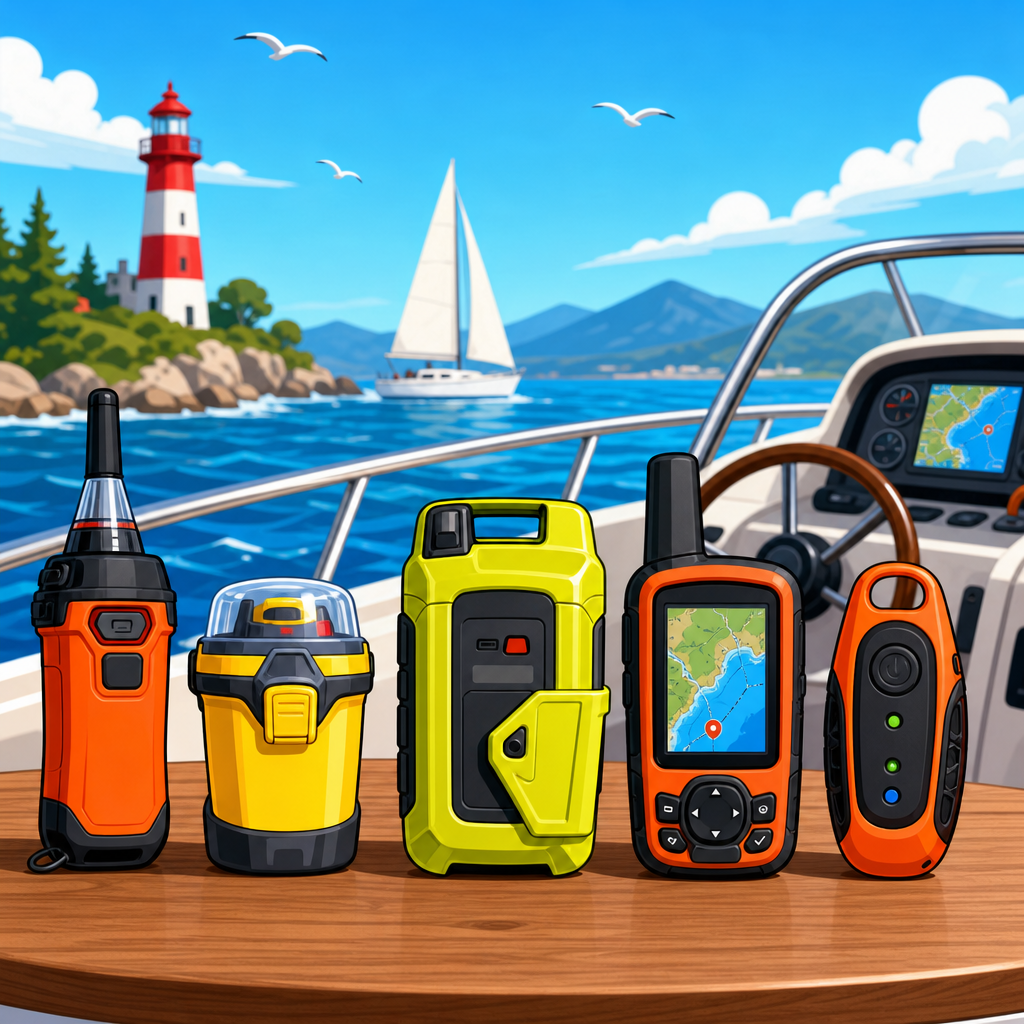
The five devices below stand out because they cover the most important boating use cases: full-vessel distress alerting, personal rescue signaling, hybrid communication, and dependable navigation backup. They are not interchangeable, but together they represent the strongest options in the current market for serious recreational boaters.
| Device | Type | Best For | Key Strength | Main Limitation |
|---|---|---|---|---|
| ACR GlobalFix V6 | EPIRB | Offshore boats | 406 MHz distress alerting with AIS and RLS features | Larger and costlier than personal units |
| ACR ResQLink 400 | PLB | Kayak, skiff, and crew backup | Compact official distress beacon | No routine messaging |
| Garmin inReach Mini 2 | Satellite messenger | Coastal and offshore trip communication | Two-way messaging and tracking | Subscription required; not a substitute for EPIRB |
| Garmin GPSMAP 86i | Handheld GPS plus satellite messaging | Navigation backup on larger boats | Marine navigation features with SOS capability | Higher price and battery management needs |
| Standard Horizon HX890 | Handheld VHF with GPS and DSC | Nearshore safety redundancy | Direct marine communications with position data | Range depends on line of sight, not satellites |
The ACR GlobalFix V6 is the strongest choice for boaters who regularly run offshore. It is a true vessel beacon, built to transmit a 406 MHz distress signal to Cospas-Sarsat satellites while also providing a homing signal for final approach. Newer EPIRBs in this class may include Return Link Service, which confirms that the distress message was received by the satellite system, and AIS functionality, which helps nearby vessels see the beacon target on compatible displays. That combination matters. In a sinking or abandonment scenario, an EPIRB remains the fastest path to formal rescue coordination, and it does not depend on a paid messaging plan or cellular towers.
The ACR ResQLink 400 is a proven PLB for crews who need personal protection. I recommend it for kayak anglers, solo skiff operators, dinghy crews, and anyone who works on deck in rough weather. Because it is worn or clipped to the person rather than mounted to the vessel, a PLB addresses one of the biggest real-world gaps in marine safety: separation from the boat. If you go overboard with the vessel drifting away, the beacon on the console is no longer helping you. A PLB solves that specific problem, though it still lacks the convenience of check-in messages.
The Garmin inReach Mini 2 occupies a different lane. It is not an EPIRB replacement, but it is one of the most useful communication tools a recreational boater can carry. Through the Iridium satellite network, it can send two-way text messages, weather requests, location sharing, and SOS alerts through a professional emergency coordination center. For families waiting ashore, that communication reduces uncertainty and lowers the chance that a routine delay becomes a false alarm. For captains, it creates a practical bridge between simple signaling and detailed coordination.
The Garmin GPSMAP 86i is ideal for boaters who want a serious handheld marine GPS with satellite messaging built in. It floats, supports marine data integration, and is designed around navigation tasks rather than only emergency texting. On larger center consoles and cruising boats, I have seen it used as a grab-and-go backup when crews leave the helm to work a fish, launch a tender, or shift to a life raft. If the main plotter fails, the handheld can still guide you to a waypoint, inlet, or safe harbor.
The Standard Horizon HX890 rounds out the top five because not every boating emergency starts offshore. Many begin close enough to shore that VHF is still the fastest and clearest communication method. The HX890 combines handheld VHF operation, internal GPS, DSC distress capability, and marine-friendly construction. In busy coastal waters, a DSC distress call with position data can reach nearby vessels and the Coast Guard immediately. It lacks the global reach of a satellite beacon, but as part of a layered system it is outstanding value.
How to Match the Right Device to Your Boating Style
The best emergency beacon and GPS device for boaters depends on where, how, and with whom you operate. A flats skiff that spends most days within sight of marinas does not need the same kit as a passagemaking sailboat or an offshore tuna boat. Start with operating area. If you regularly travel beyond reliable cell range or outside quick-response harbor zones, an EPIRB moves from optional to essential. If you boat solo, a PLB attached to your life jacket becomes far more important than a console-mounted device. If you cruise with family, two-way satellite messaging often delivers the biggest day-to-day benefit.
Vessel size also changes the equation. On a 16-foot open boat, space is tight, spray is constant, and equipment may need to be body-carried. Compact PLBs, floating handheld VHFs, and rugged handheld GPS units fit naturally here. On a 35-foot cruiser with a hardtop, fixed electronics, AIS, radar, and NMEA 2000 networking may already provide excellent navigation and communication, so the priority shifts toward abandonment scenarios: EPIRB registration, ditch bag organization, and portable backups. The more systems you have onboard, the more disciplined you must be about redundancy instead of assuming the panel solves everything.
Trip profile matters too. Anglers who drift, chase birds, or run pre-dawn departures need equipment visible and operable with cold hands and wet decks. Sailors on multiday passages need long battery life, charging strategy, and stable tracking. Paddlecraft users need one-handed controls and attachment points that survive immersion. For charter captains and boat-club operators, guest simplicity matters; gear should be easy to brief in under two minutes. When I audit a boat’s emergency setup, I ask one practical question: if the operator is injured, can another person activate the system without guessing? That question quickly reveals whether your choices are realistic.
Best Practices for Setup, Registration, and Maintenance
Buying the right device is only half the job. Registration and maintenance determine whether rescue systems work as intended. Every 406 MHz EPIRB and PLB should be registered with the appropriate national authority, such as NOAA in the United States. Registration links the beacon’s unique hexadecimal identification code to your vessel description, emergency contacts, and trip profile. When an alert is received, that data helps rescue coordinators confirm legitimacy and deploy the right resources faster. An unregistered beacon can still trigger a response, but it removes critical context at the worst possible moment.
Battery care is equally important. Distress beacons use long-life sealed batteries with replacement intervals set by the manufacturer, often measured in years rather than months. Do not ignore those dates. Replace hydrostatic release components on float-free EPIRBs according to schedule. Test units only with approved self-test functions, and log the results at the start of each season. Handheld GPS devices, VHF radios, and satellite messengers need a different discipline: regular charging, spare power options, software updates, and waterproof seal inspection. I have seen excellent devices sidelined by corroded charging contacts and expired subscriptions rather than hardware failure.
Storage and crew training close the loop. An EPIRB should be mounted where it can be reached fast and where its bracket will not be blocked by gear. A PLB belongs on the person, not inside a bag. A handheld VHF and GPS should live in the ditch bag with fresh batteries or charging leads. Then brief the crew. Show them how to lift the antenna, press the SOS key, transmit on channel 16, and read a latitude-longitude position. The strongest boating safety and emergency equipment plan is the one that still functions when the captain is cold, injured, or not available to direct every step.
Conclusion
The top emergency beacons and GPS devices for boaters do not compete for a single role; they solve different parts of the same safety problem. An EPIRB such as the ACR GlobalFix V6 is the gold standard for vessel-level distress alerting offshore. A PLB like the ACR ResQLink 400 protects the individual who becomes separated from the boat. A satellite messenger such as the Garmin inReach Mini 2 adds practical communication and tracking. A handheld navigator like the Garmin GPSMAP 86i preserves route awareness when primary electronics fail. A handheld VHF with GPS and DSC, including the Standard Horizon HX890, gives nearshore crews immediate voice communication and fast distress signaling.
If you treat this page as your hub for boating safety and emergency equipment, the main lesson is simple: build layers, not single points of failure. Match the device to your operating area, register it correctly, maintain it on schedule, and train every regular crew member to use it under stress. Those steps reduce rescue time, improve decision-making, and make every other piece of onboard safety gear more effective. Review your current setup, identify the missing layer, and upgrade it before your next trip on the water.
Frequently Asked Questions
What is the difference between an EPIRB, a PLB, and a marine GPS emergency device for boaters?
An EPIRB, or Emergency Position-Indicating Radio Beacon, is a vessel-focused distress beacon designed to alert global search and rescue networks when a serious emergency occurs offshore or on open water. It is typically registered to the boat, built for harsh marine conditions, and made to transmit an SOS signal with location data for an extended period. Many EPIRBs are designed to float, self-right, and in some cases activate automatically if the vessel sinks. That makes them a top-tier choice for offshore cruisers, passagemakers, and anyone operating where outside help may be hours away.
A PLB, or Personal Locator Beacon, works on the same core rescue network but is registered to an individual rather than the vessel. PLBs are smaller, more portable, and easy to attach to a life jacket, ditch bag, or foul-weather gear. For anglers in small boats, kayakers, crew members on larger vessels, and solo boaters, a PLB can be extremely valuable because it stays with the person if they become separated from the boat. The tradeoff is that PLBs are usually more compact and may not include some of the vessel-specific features found on full-size EPIRBs.
Marine GPS emergency devices cover a broader category. Some are dedicated chartplotters with man-overboard functions, some are handheld GPS units with distress and navigation support, and others include satellite communicators that allow two-way messaging in addition to location sharing. These devices can improve situational awareness, help crews navigate safely, and speed up rescue by providing precise coordinates, but they are not all equal in an actual mayday scenario. The key point is that a GPS helps determine where you are, while an emergency beacon is designed to send that location through recognized rescue channels. For many boaters, the best safety setup is not choosing one or the other, but pairing a proper distress beacon with a dependable marine GPS.
Do I really need an emergency beacon if I already have a VHF radio and a chartplotter on my boat?
In many cases, yes. A VHF radio and chartplotter are essential, but they do not fully replace the role of a dedicated emergency beacon. A fixed-mount VHF with DSC capability is one of the most important communication tools on board because it lets you contact nearby vessels and the Coast Guard quickly, especially when connected to GPS. A chartplotter gives you accurate navigation and position data. Together, they form a strong first line of safety. But they still depend on power, antenna performance, proximity to monitoring stations, and the crew’s ability to operate them during a high-stress emergency.
An emergency beacon adds a layer of redundancy that becomes critical when things go wrong fast. If the boat loses power, capsizes, takes on water, or must be abandoned, a chartplotter and fixed VHF may no longer be available. In those situations, a registered EPIRB or PLB can continue transmitting your distress alert and position independently. That is one reason experienced offshore boaters treat beacons as core survival equipment rather than optional electronics.
There is also a practical difference in how rescue starts. A VHF distress call works best when someone is listening and can respond quickly within radio range. A beacon is designed specifically to trigger formal search and rescue response through established systems. That can make a major difference in remote waters, during poor weather, at night, or when no nearby vessels are close enough to help. The smartest approach for most boaters is layered safety: carry a GPS-equipped chartplotter, use a properly installed DSC-enabled VHF, and add a reliable emergency beacon so you still have a lifeline if the rest of the boat’s systems fail.
Which features matter most when choosing one of the best emergency beacons or GPS devices for boating?
The most important features depend on where and how you boat, but a few rise to the top for nearly everyone. First is reliable distress signaling. For emergency beacons, that means proven satellite-based rescue transmission, integrated GPS for accurate location data, and strong battery endurance. If you run offshore, fish in changing weather, or cross busy inlets and coastal bars, these are not luxury features. They are the difference between a vague distress alert and a highly accurate rescue response.
Second is water readiness. Marine devices should be built for saltwater exposure, spray, impact, and rough handling. Look for waterproof or submersible construction, floating capability when relevant, corrosion-resistant design, and controls that are usable with wet or gloved hands. In real boating conditions, equipment has to work when dropped, soaked, or grabbed in a hurry. A device that looks good on paper but is awkward to operate in heavy seas is not the one you want when seconds matter.
Third is ease of use and deployment. The best emergency gear is intuitive under stress. A clearly protected SOS button, simple activation steps, visible status indicators, and straightforward registration or setup all matter. For GPS devices, screen readability in sunlight, chart compatibility, battery life, route marking, and man-overboard functions are especially valuable. If you boat in unfamiliar waters, a handheld backup GPS can be surprisingly useful even if you already have a fixed chartplotter.
Finally, think about fit for mission. A trailerable coastal boat may benefit most from a compact PLB and a dependable handheld GPS backup. An offshore sailboat may need a Category 1 EPIRB in a hydrostatic bracket, a fixed chartplotter at the helm, and a satellite communicator in the ditch bag. The right choice is not just about buying the most expensive device. It is about matching your emergency equipment to your cruising range, crew size, vessel type, and likely risk scenarios.
How should boaters carry, register, and maintain emergency beacons so they actually work in an emergency?
Owning a beacon is only half the job. To be effective, it needs to be registered correctly, carried where it can be reached quickly, and maintained on schedule. Registration is especially important because it links the beacon’s ID to vessel details, emergency contacts, and trip-related information. When a distress signal is received, that registration data helps rescue authorities verify the alert and respond more efficiently. If you change boats, contact details, or ownership, update the registration immediately. Outdated information can slow down the response when time matters most.
Storage and accessibility matter just as much. An EPIRB should be mounted according to the manufacturer’s guidance in a location that is easy to reach and appropriate for the device type. A PLB should be worn on the person or attached to gear that will stay with the person in the water, not buried in a locker. This is a mistake many boaters make: they buy excellent safety gear and then store it where it is hard to access during a fire, capsize, or sudden flooding event. If a device is intended for abandon-ship use, it should be part of a well-planned ditch bag or directly attached to a life jacket system.
Maintenance is what keeps a beacon from becoming false security. Check battery replacement dates, perform manufacturer-recommended self-tests, inspect seals and housing for damage, and confirm mounting brackets are secure and free of corrosion. For GPS devices, keep software updated, verify charts are current, inspect charging connections, and test battery runtime before major trips. It is also wise to practice with the device in a non-emergency setting so everyone aboard knows what it is, where it is, and how to use it. A beacon or GPS unit is most valuable when the crew can deploy it confidently without digging through manuals during a crisis.
What is the best emergency beacon and GPS setup for coastal boating versus offshore boating?
For coastal boating, a practical setup usually starts with a fixed-mount VHF radio with DSC tied into the boat’s GPS, because this allows for quick distress communication close to shore and in areas with active marine traffic. Add a reliable chartplotter or handheld marine GPS for navigation and position awareness, then consider a PLB for the skipper or each crew member, especially on center consoles, small fishing boats, paddle craft, and boats that may operate beyond immediate help. Coastal boaters often move in and out of inlets, fish alone at dawn, or make short runs that feel routine, but that is exactly when compact, easy-to-carry emergency gear proves its value.
For offshore boating, the safety standard rises. A registered EPIRB should be viewed as foundational equipment, not optional gear. Offshore conditions increase the chance that help will be far away and that communications may be interrupted by weather, distance, or vessel damage. A fixed chartplotter remains central for navigation, but it should be backed up by a handheld GPS or second independent navigation device. Many offshore crews also carry satellite communicators for two-way messaging, weather updates, and coordination support during non-immediate emergencies or evolving situations.
The best setup is ultimately layered and redundant. Coastal boaters can often get excellent protection from a strong VHF-GPS combination plus a PLB and handheld backup navigation. Offshore crews should strongly consider a full package that includes an EPIRB, fixed and backup GPS capability, a ditch bag, and person-carried signaling devices for each crew member. The goal is not simply to own impressive equipment. It is to create a safety system that still functions if