Jet skis deliver speed, freedom, and easy access to coves, shorelines, and fishing spots, but they also demand disciplined decision-making. In this guide to the top 10 boating safety tips for jet ski riders, I am treating personal watercraft safety as the core of a broader Safety & Training for Water Sports & Fishing hub, because the same habits that prevent collisions on a ski also protect anglers in small boats, paddleboarders near marinas, and families towing tubers. A jet ski, more accurately called a personal watercraft or PWC, is a compact vessel powered by an inboard jet pump, steered by thrust, and operated from a seated or standing position depending on the model. That design gives quick acceleration and tight turning, but it also creates unique risks: if you release the throttle, steering authority drops; if you ride too close to other traffic, the craft can cover distance faster than your brain processes hazards; and if you overload the machine with extra passengers or gear, handling changes immediately.
I have spent enough time around launch ramps, rental docks, and patrol briefings to know that most serious incidents do not begin with dramatic recklessness. They usually begin with simple omissions: a life jacket not zipped fully, a lanyard not clipped on, a weather check skipped, an inexperienced passenger never briefed, or a rider who assumes boating rules apply only to larger vessels. The U.S. Coast Guard consistently reports that operator inattention, improper lookout, excessive speed, and inexperience are major contributors to recreational boating accidents. For jet ski riders, those factors are magnified because the craft is small, responsive, and often used close to swimmers, docks, fishermen, and shoreline structure. Learning the right habits is not optional. It is the skill foundation that supports everything else in water sports, from wake activities to inshore fishing access and family recreation.
This article covers the ten practices that matter most: wearing proper flotation, using the engine cut-off switch, understanding local boating laws, completing hands-on training, conducting a pre-ride inspection, managing speed and distance, reading weather and water conditions, riding sober and alert, preparing for falls and emergencies, and respecting other users of the water. Together, these boating safety tips for jet ski riders create a repeatable operating system for safe days on the water.
1. Wear the right life jacket and protective gear every ride
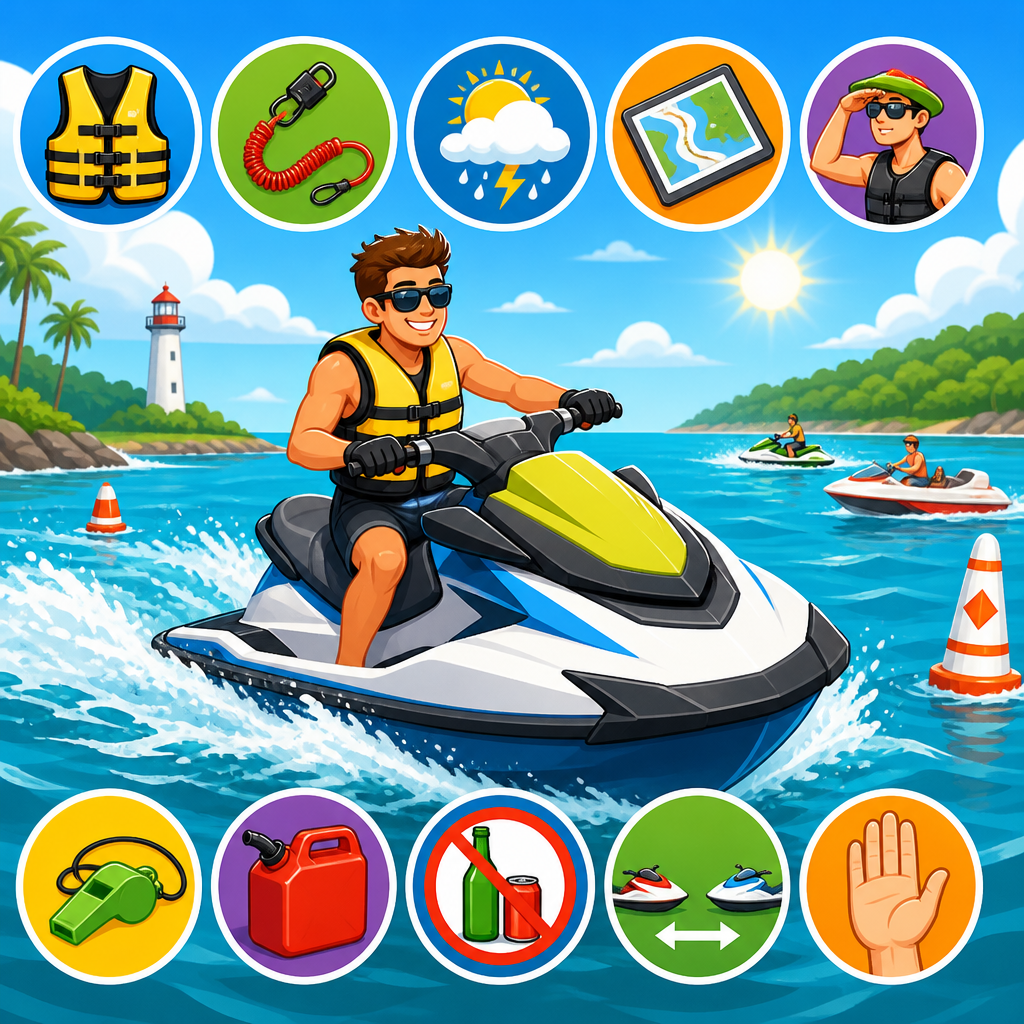
The first rule is simple: wear a Coast Guard-approved life jacket designed for PWC use, and wear it correctly. A loose vest rides up in the water and can fail when you need it most. For high-mobility riding, a Type III or performance-rated vest made for personal watercraft is usually the practical choice because it balances flotation with arm movement. Riders should also wear eye protection, a whistle, and a wetsuit bottom or neoprene shorts when conditions warrant. On fast falls, water impact is forceful, and lower-body protection matters more than many beginners realize. Footwear with grip helps at slippery ramps and floating docks, where plenty of injuries happen before the engine even starts.
Passengers need the same standard, not a lower one. I always tell new riders that lending someone a seat means accepting responsibility for their briefing and gear fit. Children require youth-specific sizing, and adults should test buckles and straps before launch. If you fish from a larger boat and use a jet ski as a shuttle, the life jacket rule does not change for quick transfers. Protective gear is the easiest risk reduction step, and it works only when used every time.
2. Attach the engine cut-off lanyard before leaving the dock
The engine cut-off switch, often called the safety lanyard, shuts the motor down if the rider is thrown from the craft. On a jet ski, this is essential because an unmanned PWC can continue moving, circle unpredictably, or drift into traffic. Clip the lanyard to your wrist, vest, or designated attachment point before you throttle away. Do not hold it loosely in your hand or assume short rides do not require it. A fall can happen in shallow chop, during an aggressive turn, or when crossing another wake at the wrong angle.
I have seen riders treat the lanyard as optional because modern machines feel stable at low speed. That is false confidence. Stability does not prevent ejection if you misjudge a wake or collide with floating debris. For instructors and rental operators, the lanyard is also a training checkpoint because it proves the rider understands the most basic emergency control. If a passenger changes position, or if you stop to swim, reconnect and confirm the switch is seated properly before restarting.
3. Know the rules of the waterway and the limits of your machine
Jet ski safety starts with legal knowledge. Every state has boating laws covering age restrictions, education requirements, speed zones, wake restrictions, towing rules, and required safety equipment. Many states require a boater education card for PWC operators, and rental operations often impose stricter standards than the law. Riders also need to know right-of-way rules, marker meanings, no-wake zones, and how local authorities define reckless operation. Ignoring these basics is one of the fastest ways to create a preventable incident.
Equally important is understanding your craft’s capacity plate, fuel range, and handling characteristics. A three-seat recreational PWC behaves differently from a performance model with higher top speed and tighter throttle response. Added coolers, fishing kits, or a second passenger change stopping distance and turning feel. If you operate in tidal passes, reservoirs, or busy inland lakes, review charts, launch maps, and local hazard notices before departure. Waterway knowledge is not paperwork; it is collision prevention.
4. Take a formal safety course and practice low-speed control
Training is the most underrated investment in water sports. A recognized boating safety course teaches navigation rules, environmental awareness, emergency response, and equipment standards in a structured format. The National Association of State Boating Law Administrators approves many state courses, and the U.S. Coast Guard Auxiliary and United States Power Squadrons provide respected instruction. For jet ski riders specifically, combine classroom learning with on-water drills. Practice launching, reboarding from deep water, throttle-on steering, idle maneuvering, lookout habits, and controlled turns in open space.
New riders usually want to practice speed first. I teach the opposite: master slow control before acceleration. Most dock strikes and near misses happen at low speed when a rider overcorrects or forgets that jet propulsion requires thrust for steering. An operator who can idle through a crowded marina, maintain spacing near anglers, and recover calmly after a stall is far safer than a rider who can sprint across open water but cannot manage a return to the trailer.
5. Use a consistent pre-ride checklist before every launch
Safe boating becomes reliable when it is procedural. Before every ride, inspect the jet ski, required gear, and ride plan. Check fuel level, battery condition, steering movement, reverse function if equipped, hull condition, drain plugs, fire extinguisher, sound-producing device, registration, and navigation lights if there is any chance of low-light operation. Test the bilge area for standing water and secure loose items so they cannot shift into footwells or blow overboard. On fishing-oriented setups, confirm rod holders, coolers, anchors, and dry bags are strapped down so they do not interfere with balance or reboarding.
| Checklist Item | What to Verify | Why It Matters |
|---|---|---|
| Fuel and range | Enough fuel for ride, reserve, and detours | Prevents stranding and poor decisions late in the trip |
| Steering and controls | Smooth operation, no binding, lanyard working | Critical for avoiding collisions and regaining control |
| Safety gear | Life jackets, whistle, extinguisher, phone or radio | Supports rescue, signaling, and legal compliance |
| Weather and route | Wind, storms, tides, hazards, return time | Reduces exposure to changing conditions |
That checklist applies beyond PWCs. Kayak anglers, tow-sport boaters, and small skiff operators all benefit from the same habit because equipment failures rarely announce themselves in advance. Five minutes at the ramp can save hours of rescue coordination later.
6. Control speed, maintain distance, and keep a full lookout
Speed is not inherently unsafe; unmanaged speed is. The practical rule is to ride at a speed that matches visibility, traffic density, water surface, and your stopping margin. Leave more distance than feels necessary, especially around docks, moored boats, swimmers, paddle craft, and shoreline anglers. A jet ski closes gaps quickly, and people in kayaks or jon boats may not hear you soon enough to react. Keep a 360-degree scan going, not just a forward stare. Check behind you before turns, monitor crossing traffic, and anticipate wakes from larger vessels.
One pattern I see often is target fixation: riders look at the object they want to avoid and drift straight toward it. Train your eyes on the escape path instead. Another common mistake is cutting closely behind another vessel. The operator ahead may slow unexpectedly, turn, or throw a wake that unsettles your craft. Good lookout discipline is what turns raw handling ability into true boating safety.
7. Respect weather, water temperature, and local conditions
Weather changes faster on the water than on land, and jet skis expose riders directly to wind, spray, lightning risk, and cold shock. Check a trusted marine forecast before launch using NOAA Weather Radio, a marine weather app, or a local harbor source. Focus on wind speed, gusts, thunderstorm timing, wave height, advisories, and water temperature. Wind matters as much as rain because short, steep chop can exhaust riders quickly and make reboarding harder. Cold water deserves special attention: immersion can impair breathing and coordination within minutes, even on mild air-temperature days.
Local conditions deserve equal weight. River current, tidal flow, submerged stumps, sandbars, ferry lanes, and afternoon lake traffic all affect route planning. On large reservoirs, a calm morning can turn into whitecaps by midday. In coastal areas, outgoing tide against onshore wind can create rough inlets that challenge even experienced riders. Conservative timing is smart seamanship, not timidity.
8. Never ride impaired, fatigued, or distracted
Alcohol and boating are a dangerous combination, and the law treats boating under the influence seriously for good reason. Sun, vibration, heat, dehydration, and glare amplify impairment on the water. A rider who feels “fine” onshore may have delayed reaction time and poor judgment after an hour of exposure. The same applies to fatigue. Long tow days, repeated high-speed runs, and skipped meals degrade awareness. If you are tired, head in early.
Distraction is the quieter hazard. Phones, action cameras, fishing electronics, and conversations with passengers can pull your eyes off the water at exactly the wrong moment. Set routes and devices before departure, and stop in a safe area if you need to adjust gear. On a PWC, attention is your primary collision-avoidance tool.
9. Prepare for falls, reboarding, and emergencies before they happen
Every rider should know how to fall, recover, and call for help. If you are thrown off, account for your passenger first, then approach the craft as directed in the owner’s manual; many models specify a reboarding side to prevent rollover. Practice deep-water reboarding in calm conditions before you need it in waves. Carry a waterproof phone case or VHF radio where it remains accessible after a fall, not buried in a hard-to-reach hatch. Tell someone onshore where you are launching, your route, and your expected return time.
Emergency readiness also means understanding basic first aid and rescue priorities. A rider with a propeller boat nearby may face different hazards than one stranded offshore with mechanical failure, but the response framework is the same: stabilize people first, signal clearly, then manage the vessel. If you ride in remote areas, a personal locator beacon can be a smart addition.
10. Share the water responsibly with anglers, swimmers, and other boaters
Jet ski riders operate in mixed-use environments, and courtesy is a safety skill. Slow early in no-wake zones, give bank fishermen and paddlers wide berth, avoid repeated passes near swimmers, and never spray or jump wakes around congested traffic. If you tow tubes or wake toys from a PWC where legal, use an observer when required and maintain a larger safety buffer than the minimum rule suggests. Noise, wake, and proximity affect other people’s safety long before they become legal issues.
This is why jet ski safety belongs at the center of a wider Safety & Training for Water Sports & Fishing hub. The habits that protect a PWC rider also support respectful coexistence across the water: communication, spacing, route planning, and awareness of vulnerable users. Better behavior from one group improves conditions for everyone.
The top 10 boating safety tips for jet ski riders are straightforward, but they work only when they become routine. Wear a proper life jacket, clip on the lanyard, know the law, get trained, inspect the craft, manage speed, watch the weather, stay sober, prepare for emergencies, and respect everyone sharing the water. These practices reduce accident risk, improve confidence, and make every kind of water recreation more enjoyable, whether you are riding for fun, scouting fishing water, or supporting family activities from a launch beach. Start by reviewing your local boating regulations and booking a certified safety course before your next ride.
Frequently Asked Questions
What is the most important safety rule for jet ski riders?
The single most important safety rule for jet ski riders is to operate with control, awareness, and enough space to react. A personal watercraft can accelerate quickly, turn sharply, and reach high speeds in a short distance, which means small mistakes can become serious incidents fast. Riders should always wear a properly fitted U.S. Coast Guard-approved life jacket, attach the engine cut-off lanyard to their body, maintain a safe speed for conditions, and keep a constant lookout in every direction. Unlike larger boats, jet skis are often used close to shore, around swimmers, anglers, docks, and other recreational traffic, so defensive riding matters just as much as technical skill.
It also helps to think beyond your own machine. The best riders understand that boating safety is shared space safety. Your decisions affect kayakers crossing a channel, families loading boats at a ramp, and fishermen anchored near points or coves. Staying sober, avoiding reckless maneuvers, respecting no-wake zones, and leaving plenty of stopping distance are not just legal recommendations in many areas; they are the foundation of responsible riding. If a rider remembers one rule above all, it should be this: never operate faster or closer than your ability to safely assess, react, and stop.
Why is wearing a life jacket and using the safety lanyard so important on a jet ski?
A life jacket and safety lanyard are two of the most critical pieces of protection on a jet ski because they work together during the exact type of incident that happens most often: an unexpected fall or ejection. A life jacket helps keep the rider afloat, supports the body in rough water, and reduces exhaustion while waiting to remount or receive help. Even strong swimmers can become disoriented after hitting the water at speed, especially in cold water, choppy conditions, or heavy traffic. A properly fitted life jacket is designed for impact and movement, and it should be worn at all times, not stored under a seat where it cannot help in an emergency.
The engine cut-off lanyard is just as important because it shuts the engine down if the rider is thrown off. Without it, a jet ski can continue moving, circle back, drift into hazards, or leave the rider separated from the craft. In busy waterways, that creates a major risk for the operator and everyone nearby. The lanyard should be attached securely to the rider’s wrist, life jacket, or designated attachment point every time the craft is in motion. Together, these two simple safety measures dramatically reduce the severity of many common accidents and should be treated as non-negotiable every time you launch.
How fast is too fast when riding a jet ski?
There is no single speed that is always safe or always unsafe, because appropriate speed depends on visibility, traffic, water depth, weather, wave action, local regulations, and rider experience. The better question is whether you can maintain full control and stop or turn safely within the space available. On a calm, open stretch of water with excellent visibility and minimal traffic, a moderate increase in speed may be manageable for an experienced rider. In a marina, near docks, around anglers, in narrow channels, near swimmers, or in rough water, even a speed that feels relatively slow can still be unsafe if it reduces your reaction time.
Jet skis require responsible throttle management because they are highly responsive and can cover distance very quickly. Riders should slow down well before entering congested areas, obey no-wake and posted speed zones, and avoid sudden acceleration near other water users. They should also remember that personal watercraft steering is linked to propulsion on many models, which means reduced throttle can affect maneuverability. That is why good safety habits include planning ahead, leaving generous buffers, and avoiding the temptation to ride aggressively in unpredictable environments. If you are close enough that another boater, paddler, or swimmer forces you to make a sudden decision, you were likely going too fast for the conditions.
What should a beginner know before taking a jet ski out for the first time?
A beginner should understand that jet skis may feel easy to operate at first, but safe operation requires training, judgment, and familiarity with the craft’s handling. Before heading out, first-time riders should review local boating laws, age requirements, and any education or licensing rules that apply in their state or area. They should also learn the controls on the specific model they are using, including throttle response, steering behavior, engine shut-off procedures, reboarding technique, and fuel range. A full pre-ride check is also essential: inspect the life jackets, confirm the lanyard works, check weather and water conditions, verify fuel levels, and make sure all required safety equipment is onboard.
Just as important, beginners should practice in a low-traffic area with calm water before attempting longer rides or higher speeds. They need to learn how the craft accelerates, how it turns, how long it takes to stop, and how to maintain awareness while scanning for hazards. New riders should avoid carrying passengers until they are comfortable controlling the craft alone, and they should never ride in poor weather, at night if not permitted or advised, or in crowded launch areas without confidence and patience. A boating safety course is one of the smartest first steps because it teaches right-of-way rules, emergency response, and hazard recognition in a way that helps prevent beginner mistakes before they happen on the water.
How can jet ski riders stay safe around fishermen, paddleboarders, swimmers, and other boaters?
The key is to ride with the assumption that smaller, slower, or less maneuverable water users need extra room and extra courtesy. Fishermen may be focused on lines, drift, and structure rather than your approach. Paddleboarders and kayakers sit low in the water and can be hard to see in glare or chop. Swimmers may surface unpredictably, and families towing tubers or skiers need wide turning space. Safe jet ski operation means slowing down early, passing at a generous distance, avoiding wake-heavy approaches in confined areas, and never cutting behind or between vessels, people, or gear where your speed and spray can create unnecessary danger.
Good situational awareness is what ties all of this together. Riders should scan constantly, watch for anchored boats, floating lines, channel markers, sandbars, and changing traffic patterns, especially near marinas, coves, and shorelines. It is also smart to minimize abrupt maneuvers that make your intentions hard to predict. In many mixed-use areas, the most professional thing a rider can do is operate smoothly, visibly, and respectfully. That protects not only the jet ski operator, but everyone sharing the water. When riders treat personal watercraft safety as part of a broader boating safety mindset, they help create a safer environment for anglers in small boats, paddlers near launch points, and families enjoying the water in different ways.