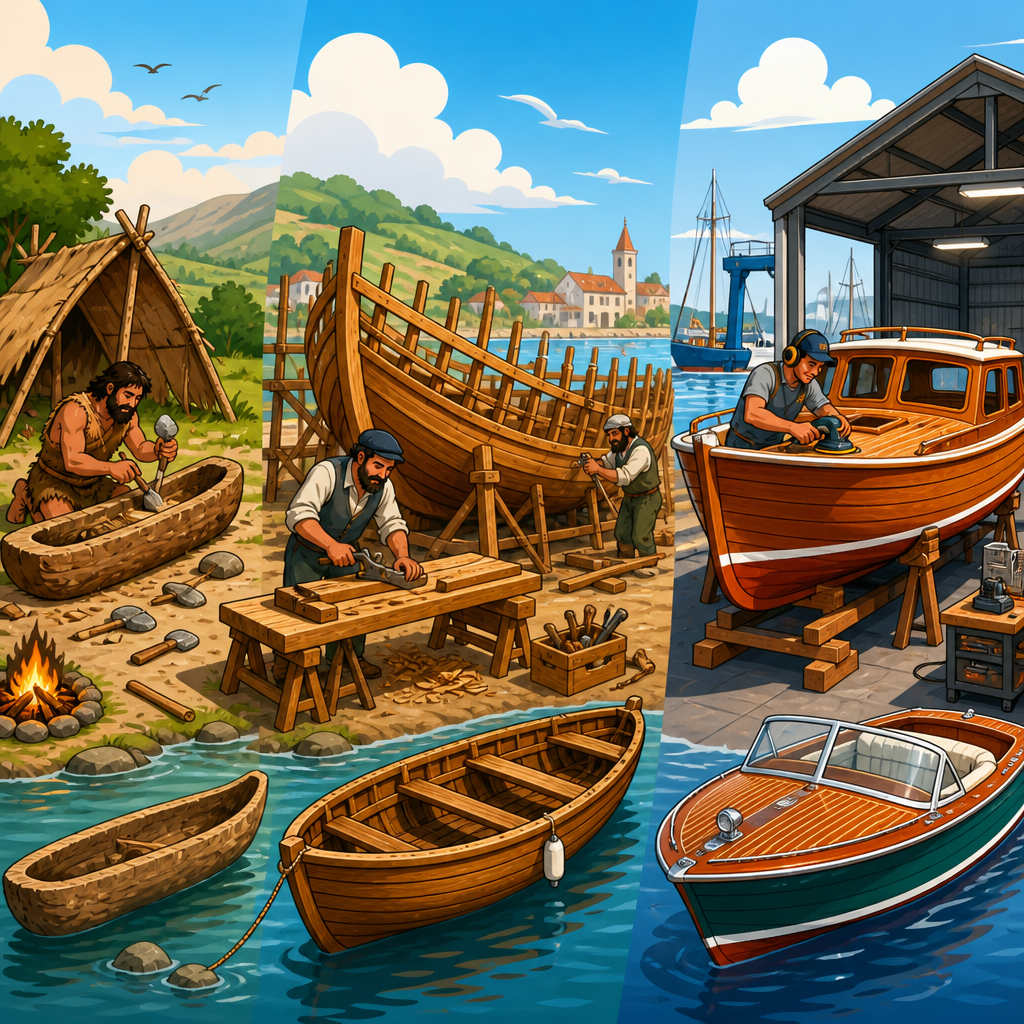
Wooden boat building techniques have evolved over thousands of years, yet the core challenge has remained the same: shaping timber into a hull strong enough to survive wind, waves, cargo, and time. In the broad world of historic and classic boats, construction method is the key that explains why a Viking longship flexed in open water, why a Venetian gondola carries its distinctive asymmetry, why a New England dory could be built quickly and cheaply, and why a luxury mahogany runabout still turns heads at a marina. For anyone exploring types of boats, this historic and classic boats hub starts with the material itself. Wood was available, repairable, buoyant, and workable with hand tools long before steel, fiberglass, or aluminum became practical for small and medium craft.
When I discuss wooden boat building techniques, I am referring to the systems used to assemble the hull, internal framing, planking, fastenings, and protective coatings of a vessel. Terms such as dugout, clinker, carvel, lapstrake, strip planking, cold molding, steam bending, caulking, and lofting describe very different ways of solving structural problems. Some methods prioritized speed of construction, some minimized material use, some handled beach landings, and others delivered smooth hulls capable of carrying heavy loads. The result is not a single tradition but a long chain of innovations shaped by geography, timber species, trade, warfare, and craftsmanship.
This matters because historic boat design is really a record of technological adaptation. Boatbuilders worked within strict limits: available forests, iron supply, climate, local waters, and the skill of the yard. A fishing community on a rocky coast built differently from a river trader, a naval dockyard, or a pleasure-boat shop serving wealthy owners. Understanding those choices helps readers identify major classic boat families and see how later methods borrowed from earlier ones. It also explains modern restoration decisions, since preserving a wooden vessel demands respect for the original structure rather than cosmetic repair alone. Whether you are studying classic sailing craft, early working boats, or iconic wooden motorboats, the evolution of technique reveals why each boat looks and performs the way it does.
From Dugouts to Shell-First Construction
The earliest wooden boats were often dugouts: a single log hollowed by controlled burning, adzing, and scraping. Archaeological finds such as the Pesse canoe in the Netherlands, dated to roughly 8000 BCE, show how effective this basic method could be in sheltered water. Dugouts required minimal joinery, but they were limited by the size and shape of the log. Builders later expanded capacity by adding washstrakes, carved end pieces, or outriggers. In many regions, dugouts remained practical for millennia because they were durable, easy to maintain, and ideal for rivers, estuaries, and lakes.
As boatbuilders sought larger hulls, they moved beyond a single timber and developed shell-first construction. In shell-first building, the outer planking was assembled before much of the internal framing. The ancient Egyptians used planked hulls joined by mortise-and-tenon joints, lashing, and dowels; the Khufu ship, discovered near the Great Pyramid, is one of the most famous examples. Mediterranean builders refined these joinery systems into highly engineered cargo and war vessels. The shell itself carried much of the structural load, and frames were inserted later to support the shape. That order of assembly differs sharply from many later methods, where a skeleton of frames comes first.
Shell-first methods mattered because they allowed larger displacement and more refined hull forms than a dugout could provide. They also demanded precision. If edge joints were weak, the hull opened under load. If the timber seasoning was wrong, planks distorted before fastening. In restoration work, I have seen how even a small mismatch in plank bevel can affect an entire run of seams. Ancient builders solved these problems with careful timber selection, repeatable geometry, and local knowledge passed through workshops rather than textbooks. Their success laid the foundation for the major traditions that followed in Northern Europe, the Mediterranean, Asia, and the Pacific.
Clinker and Lapstrake Building in Northern Waters
Clinker construction, also called lapstrake, became one of the defining wooden boat building techniques of Northern Europe. In this method, each plank overlaps the plank below it, and the laps are fastened with rivets, clenched nails, or roves. The resulting hull is light, resilient, and relatively easy to build without massive framing. Viking ships are the best-known clinker examples. The Gokstad and Oseberg ships demonstrate how thin, overlapping planks could create a strong yet flexible hull able to handle coastal voyaging and open-sea passages. That flexibility was an advantage in rough water because the structure could absorb energy rather than resist it rigidly.
Clinker building spread widely because it suited available materials and operating conditions. Oak split cleanly along the grain, producing planks with excellent strength. Small craft such as skiffs, tenders, Whitehall rowboats, peapods, and many traditional fishing boats used lapstrake planking for the same reasons the Vikings did: low weight, good stiffness, and efficient construction. In Britain and Scandinavia, builders paired the planking with steamed timbers or sawn frames after the shell was assembled. The laps also gave the hull longitudinal reinforcement, reducing the need for excessively heavy internal structure.
There were tradeoffs. The exterior was not as smooth as a flush-planked hull, and cleaning, painting, and seam maintenance around laps required care. Clinker hulls generally did not scale upward for very large cargo capacity as efficiently as flush-planked systems. Still, for small and medium classic boats, lapstrake remains one of the most elegant and practical methods ever developed. Many modern wooden-boat schools still teach it because it reveals core skills: lining off planks, spiling shapes, riveting correctly, and controlling hull fairness by eye as much as by measurement.
Carvel Planking and the Rise of Large Classic Hulls
Carvel planking changed the scale and appearance of wooden boats. In a carvel-built hull, planks meet edge to edge, creating a smooth outer skin over a substantial framework. This method became dominant in southern Europe and eventually in naval and commercial shipbuilding because it supported larger hulls, greater cargo volume, and cleaner lines through the water. As Atlantic trade expanded from the late medieval period onward, carvel construction helped make possible caravels, carracks, galleons, merchant brigs, schooners, and later working fishing vessels and yachts.
The structural logic is straightforward. Frames, floors, futtocks, keel, stem, and sternpost establish the vessel’s shape. Planks are then fastened to that skeleton, usually with iron or bronze fastenings depending on the era and budget. Seams are caulked with cotton or oakum and sealed with compounds to create a watertight skin. The smoother surface reduced drag compared with heavily lapped planking on large hulls, and repairs to individual strakes could be managed by experienced shipwrights. In classic yacht construction, carvel planking became the benchmark of prestige because it combined beauty with serious offshore capability.
Carvel’s disadvantages were weight, labor intensity, and ongoing maintenance. A carvel hull needs swelling wood to keep seams tight, which is why neglected boats often leak badly when relaunched after drying out. Fastener corrosion, frame rot, and seam movement can become expensive structural issues. Even so, many of the most admired historic and classic boats use this method: Herreshoff designs, working sloops, pilot cutters, Chesapeake buyboats, and countless custom sailboats built before fiberglass became standard. If lapstrake represents lightness and flexibility, carvel represents scale, smoothness, and the mature craft tradition of the classic wooden hull.
Regional Traditions, Working Boats, and Design by Use
Wooden boat building techniques did not evolve in isolation; they evolved around jobs. A Banks dory was built for cod fishing and nested efficiently aboard schooners. An Adirondack guideboat was optimized for rowing speed and portage weight. A Venetian gondola used complex asymmetry so one oarsman could propel and steer effectively. A Chesapeake deadrise developed to work in shallow waters while carrying oyster dredging gear. In each case, the hull shape and construction method answered a practical requirement before it became an aesthetic tradition.
| Boat type | Typical technique | Primary purpose | Why the method fit |
|---|---|---|---|
| Viking longship | Clinker | Raiding, trade, exploration | Light, flexible hull for speed and beaching |
| Banks dory | Lapstrake or simple plank-on-frame variants | Offshore fishing | Cheap, fast to build, stable with load |
| Gondola | Complex framed planking | Urban passenger transport | Asymmetrical form improved one-oar handling |
| Herreshoff yacht | Carvel | Racing and cruising | Smooth, fair hull with strong framing |
| Mahogany runabout | Seam batten or cold-molded variants | Recreation and speed | Light weight and polished finish suited planing hulls |
These regional working boats form the backbone of any historic and classic boats guide because they show technology responding directly to environment. Flat-bottomed river craft favored simple bottoms and replaceable planks. Surf-launched lifeboats needed buoyancy, flare, and robust fastening schedules. Tropical traditions often relied on different species, including teak, which resists rot and marine borers better than many temperate woods. Pacific and Asian craft also demonstrate sophisticated stitched-plank and lashed-lug methods that Western overviews sometimes overlook, even though they were highly advanced for local conditions.
When readers explore classic boats by type, they should not separate appearance from construction. The high bow of a pilot boat, the hard bilges of a dory, or the wineglass stern of a launch all connect to a build method and intended service. That is why a sub-pillar on historic and classic boats works best as a hub: each famous boat category, from canoes to cutters to commuter yachts, makes more sense once the underlying technique is understood.
Industrial Tools, Steam Bending, and the Motorboat Era
The nineteenth and early twentieth centuries transformed wooden boat construction without abandoning wood itself. Sawmills improved plank consistency. Copper and bronze fastenings became more available for quality craft. Steam boxes allowed builders to bend ribs and frames accurately into tight hull shapes. Mechanical planers, band saws, and better adhesives improved speed and repeatability. These changes supported production boatbuilding while preserving much of the hand-skill tradition. A well-run yard could now turn out fishing craft, tenders, launches, and yachts with greater uniformity than earlier village shops.
Steam bending deserves special attention because it unlocked efficient framing. By heating green timber with steam, builders softened lignin enough to bend ribs into shape without cutting across grain as severely as sawn futtocks would. White oak became a standard species for bent frames in North America and Europe because of its strength and bending characteristics. The process required timing, clamping, and experience; once a rib came out of the steam box, there was little time to hesitate. Even today, watching a crew bend a hot rib into a hull teaches more about traditional wooden boat building than hours of theory.
The arrival of internal combustion engines also changed classic wooden boats. Displacement sail hulls were joined by launches, utility skiffs, patrol boats, and polished planing runabouts from firms such as Chris-Craft, Hacker-Craft, and Gar Wood. These boats demanded tighter tolerances, lighter structures, and hull forms suited to engine vibration and higher speed. Techniques such as seam batten construction, diagonal planking, and eventually cold-molded veneers helped builders create stronger, lighter motorboat hulls. The classic wooden motorboat is therefore not simply an old sailboat with an engine; it represents a technical shift in framing, fastening, and hydrodynamic expectations.
Plywood, Epoxy, Cold Molding, and Modern Preservation
The twentieth century introduced materials and methods that bridged traditional craftsmanship and modern performance. Marine plywood, standardized under rules such as BS 1088, made it possible to build stable, lightweight hull panels with far less seasonal movement than solid planking. Designers like Jack Holt and later home-build plan providers embraced plywood for dinghies and small cruisers because it reduced cost and construction time. Stitch-and-glue methods, while newer than classic plank-on-frame work, still belong in the longer story of wooden boat evolution because they rely on wood composites rather than pure timber planking.
Cold molding marked an even bigger leap. In a cold-molded hull, thin veneers are laid diagonally in multiple layers over a mold or framework and bonded with adhesive, now usually epoxy. The result is a monocoque or semi-monocoque structure with excellent strength-to-weight ratio, smooth surfaces, and reduced leaking compared with traditionally caulked seams. Designers and builders used resorcinol glue before epoxy became dominant, though resorcinol required tight joints and careful clamping. Modern classic-inspired yachts often use cold molding to preserve the look of wood while minimizing maintenance weaknesses associated with carvel seams.
Preservation today depends on understanding what should and should not be modernized. Refastening a carvel hull with silicon bronze may be sensible; sheathing a historically important hull in fiberglass often traps moisture and accelerates rot if done poorly. The best restorers follow standards from organizations such as the American Boat and Yacht Council where applicable, document original scantlings, and distinguish between conservation, restoration, and replica building. If you own or admire historic and classic boats, that distinction matters. A museum-grade restoration aims to retain original fabric. A usable classic may accept discreet upgrades for safety and longevity. Both approaches are valid when the structural logic is clear.
The evolution of wooden boat building techniques is the story of problem-solving in timber, from dugout canoes to cold-molded yachts. Every major classic boat category reflects a build method shaped by local wood, available tools, intended waters, and the work the boat had to do. Clinker construction delivered light, resilient hulls for northern coasts. Carvel planking enabled larger, smoother vessels for trade, war, and yachting. Steam bending, improved fastenings, and engine-driven design expanded what wooden hulls could achieve. Plywood and epoxy did not erase tradition; they extended it into new forms.
For readers exploring types of boats, historic and classic boats make the most sense when viewed through construction technique rather than nostalgia alone. Method explains form, maintenance, cost, and performance. It also guides deeper reading into specific subtopics such as Viking ships, classic yachts, working fishing craft, wooden runabouts, and traditional regional boats. If you want to understand why classic boats endure, study how they were built, how they were used, and how skilled builders still preserve them today. Start with the techniques, and the entire history of wooden boats becomes easier to navigate.
Frequently Asked Questions
How have wooden boat building techniques changed from ancient times to the modern era?
Wooden boat building has evolved from highly localized craft traditions into a more systematic blend of design, engineering, and fine woodworking, but the central problem has always been the same: how to turn timber into a hull that is strong, watertight, and efficient on the water. In the earliest periods, builders relied on the natural shapes of available wood, simple hand tools, and hard-earned regional knowledge passed from one generation to the next. Many early boats were built shell-first, meaning the outer planking defined the shape of the vessel before internal framing was added. This approach appears in several ancient and medieval traditions because it allowed skilled builders to create surprisingly capable hulls without modern plans, calculations, or industrial tools.
Over time, construction methods became more specialized. Builders developed distinct systems such as clinker, or lapstrake, planking, where overlapping boards created a light but resilient hull, and carvel planking, where edge-joined planks formed a smoother outer surface better suited to larger and more heavily built vessels. As trade, warfare, and fishing demands increased, boatbuilders adapted their methods to local waters and practical needs. Long, flexible ships for open coasts, flat-bottomed workboats for shoal waters, and elegant urban craft for protected canals all emerged from differences in timber supply, intended use, and launching conditions.
By the nineteenth and early twentieth centuries, wooden boat building became more standardized in many regions. Sawn lumber was more readily available, metal fasteners improved, steam bending made frames easier to shape, and formal lofting methods allowed builders to reproduce designs with greater accuracy. In the modern era, even traditional wooden boats often combine historic forms with updated adhesives, sealants, and preservation techniques. So while the visual romance of wooden boats remains deeply tied to the past, the evolution of their construction reflects centuries of practical problem-solving, technological adaptation, and environmental understanding.
What is the difference between clinker and carvel planking, and why does it matter in boat history?
Clinker and carvel planking are two of the most important wooden hull construction methods in maritime history, and understanding the difference between them helps explain why certain boats looked, moved, and performed the way they did. In clinker construction, each plank overlaps the one below it, creating a stepped or ridged hull surface. This technique is strongly associated with northern European traditions, including Viking ships, later Scandinavian craft, and many British working and pleasure boats. The overlapping planks are fastened together in a way that produces a hull that is relatively light, flexible, and strong for its weight. That slight flexibility was not a flaw; in many cases it helped vessels absorb the stresses of rough water.
Carvel construction works differently. Instead of overlapping, the planks are laid edge to edge over a framework so that the outer hull appears smooth. This smooth surface can reduce drag and allows for broader, fuller hull forms that are often better suited to larger cargo vessels, warships, and more complex sailing craft. Carvel planking became especially important in the Mediterranean and later in Atlantic shipbuilding because it supported bigger boats with heavier framing and greater carrying capacity. It also allowed builders to create shapes that would have been difficult to achieve with overlapping planks alone.
The historical importance of these methods goes well beyond appearance. Clinker construction often reflects a boatbuilding culture focused on lightness, speed, beach launching, and relative economy of materials, while carvel construction points to a different set of priorities such as scale, smooth hull form, and structural mass. When historians identify whether a boat is clinker- or carvel-built, they are often uncovering much more than a technical detail. They are seeing evidence of geography, trade networks, naval requirements, timber availability, and local craftsmanship traditions. In that sense, planking style is one of the clearest windows into the evolution of wooden boat building itself.
Why were some historic wooden boats designed to flex, while others were built to be rigid?
Not all strength in wooden boat building comes from stiffness. In many traditional craft, controlled flexibility was actually an advantage. Boats such as Viking longships were built for demanding conditions that included surf landings, open-sea travel, and hauling ashore. Their construction methods, especially the use of clinker planking combined with relatively light framing, gave them a degree of elastic movement. Rather than fighting every force with brute rigidity, these hulls could yield slightly under stress, helping distribute loads from waves and reducing the chance of catastrophic structural failure. In practical terms, a boat that could move with the sea sometimes survived better than one that tried to resist it absolutely.
Other boats needed a very different structural character. Vessels designed to carry heavy cargo, support masts with substantial sail plans, or maintain precise hull shapes for speed and capacity often benefited from greater rigidity. Carvel-built ships with heavier frames, thicker planking, and stronger internal reinforcement were better suited to these demands. A more rigid hull could hold its intended form under load, preserve seam alignment, and support larger dimensions. This mattered greatly for merchant ships, naval vessels, and later high-style powerboats, where strength, capacity, and finish were major priorities.
The balance between flexibility and rigidity depended on environment, function, and available materials. Builders were not choosing one abstract ideal over another; they were responding to real-world conditions. A lightweight coastal craft pulled onto a beach needed different structural behavior than a deep-hulled vessel crossing oceans with cargo. This is one reason wooden boat building is so fascinating historically. The “best” method was rarely universal. Instead, successful builders understood how wood behaves, how fasteners loosen or hold, how hulls react to wave energy, and how much movement a boat could tolerate. The result was a wide spectrum of designs in which both flexibility and rigidity had their place.
How did local needs and regional traditions shape different wooden boat types such as gondolas, dories, and runabouts?
Regional boatbuilding traditions developed because water conditions, working needs, available timber, and cultural preferences varied enormously from place to place. A Venetian gondola is a perfect example of a highly specialized wooden craft shaped by a unique environment. It evolved for use in narrow, shallow canals and for propulsion by a single oarsman standing off-center. Its famous asymmetry is not decorative eccentricity; it is a deliberate design response that helps the boat track properly despite unequal loading and one-sided rowing forces. That kind of refinement only emerges when a construction tradition is deeply tied to one setting over many generations.
The New England dory reflects a very different kind of practicality. Dories were valued because they could be built quickly, relatively cheaply, and in forms well suited to fishing and utility work. Their flat or nearly flat bottoms, flared sides, and straightforward plank arrangements made them efficient working boats for coastal waters and banks fisheries. They nested well in some variants, were easy to handle, and offered a remarkable amount of usefulness for the labor and material invested. In this case, the building method and hull form were shaped by economic necessity as much as by seamanship.
Luxury mahogany runabouts came from yet another context: the rise of leisure boating, precision woodworking, and aesthetic prestige in the late nineteenth and early twentieth centuries. These boats emphasized smooth lines, polished finishes, and refined joinery. Their construction drew on advances in tooling, fasteners, engines, and finishing techniques, while still relying on deep knowledge of timber behavior and hull structure. They were built not just to float and function, but to impress.
These examples show that wooden boat design is never just about hull geometry. It is also about labor systems, local waterways, intended speed, hauling methods, social status, and the cost of materials. Regional traditions preserved methods that solved recurring local problems exceptionally well, which is why wooden boats from different parts of the world can look so distinct while all answering the same fundamental challenge of survival and performance on the water.
Why do traditional wooden boat building techniques still matter today?
Traditional wooden boat building techniques still matter because they preserve a vast body of practical engineering knowledge that modern materials alone cannot replace. Wood behaves differently from steel, aluminum, or fiberglass. It swells, shrinks, bends, and distributes stress in ways that demand a particular understanding of grain, fastening, joinery, sealing, and maintenance. Historic techniques teach builders how earlier craftspeople solved these problems with remarkable precision long before computer modeling or synthetic compounds existed. For restorers, museum professionals, and serious boat owners, that knowledge is essential if classic vessels are to remain authentic, safe, and functional.
These techniques also matter because they explain history in a tangible way. A wooden boat is not simply an object; it is a record of trade, war, fishing, transportation, social life, and regional identity. The way planks overlap, the shape of frames, the choice of timber, and the style of fastenings all reveal the priorities of a particular time and place. Preserving traditional methods allows historians and craftspeople to interpret boats as working technologies rather than as static antiques. Rebuilding a dory, repairing a lapstrake skiff, or conserving a classic runabout can uncover details that written records never captured.
Finally, traditional wooden boat building continues to inspire because it combines functionality with craftsmanship at a very high level. Even when modern adhesives, coatings, and tools