Fly fishing from a boat changes the game because your position on the water becomes as important as your cast. The best anchoring techniques for fly fishing boats are the methods that hold a skiff, drift boat, raft, or jon boat exactly where the presentation needs to happen, without spooking fish or putting anglers at risk. In practical terms, anchoring includes more than dropping weight overboard. It covers boat control, anchor selection, bottom conditions, rope scope, current angle, wind management, and fast release procedures. After years of guiding and fishing rivers, reservoirs, and tidal flats, I have found that anglers usually lose fish and waste prime water for one reason: poor positioning, not poor fly choice.
For a hub page on fly fishing from a boat, anchoring deserves center stage because it connects every other decision. Casting lanes, line management, mending, spotting fish, netting, and fish handling all depend on where the boat sits. A drift boat on a tailwater needs controlled pauses above seams. A flats skiff needs quiet stake-out positioning within casting range of cruising redfish. A lake boat targeting carp or trout may need to hold on a wind line without swinging. Good anchoring lets one angler fish while another rows or works the motor, and it creates repeatable presentations to structure, drop-offs, weed edges, and feeding lanes. Bad anchoring creates drag, crossed lines, hull slap, and dangerous broadsides. Understanding a few reliable techniques gives anglers a system they can adapt across nearly every fly fishing situation from moving rivers to open stillwater.
Choose the Right Anchor System for the Water You Fish
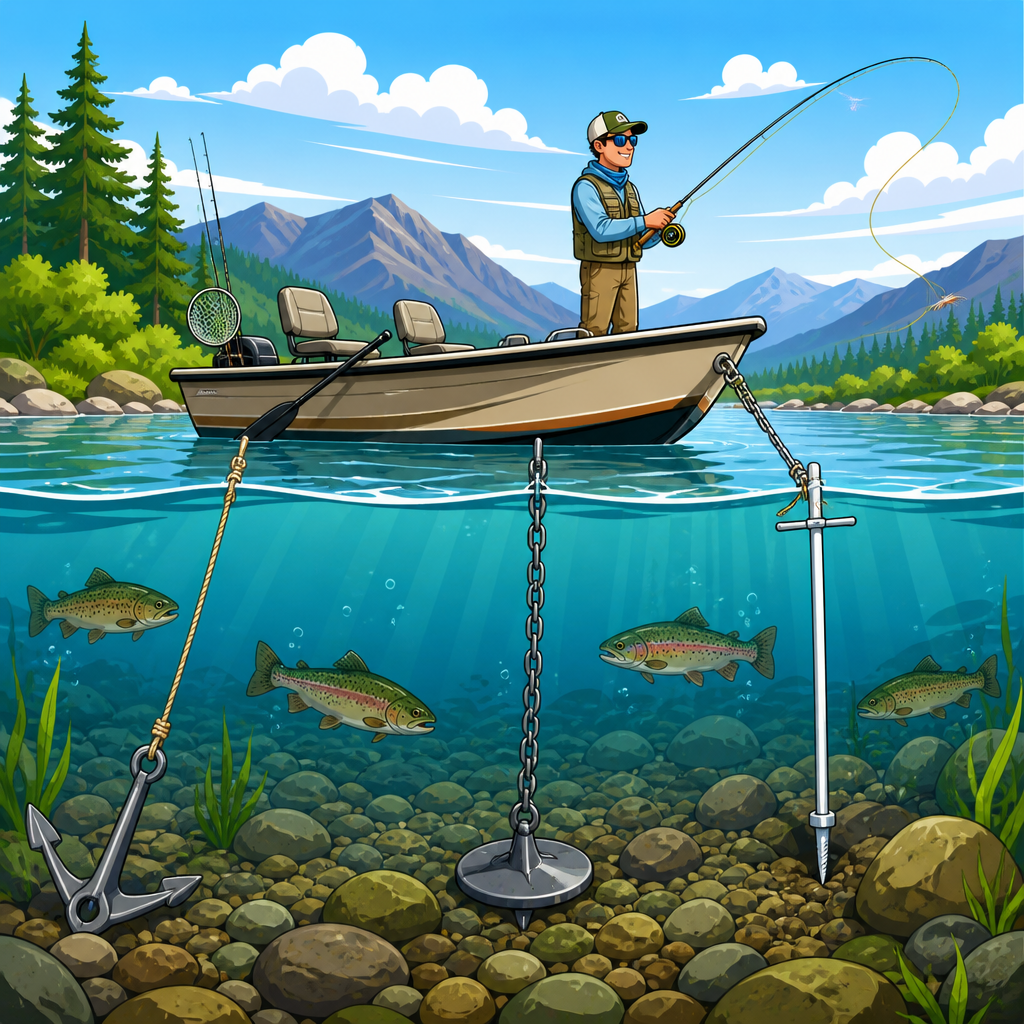
The right anchor system depends on hull type, bottom composition, and current or wind strength. For drift boats and rafts on rivers, the common setup is a stern-mounted pyramid or lead anchor controlled by a pulley and cam cleat. That system allows quick drops and controlled lifts, but it is designed to slow and position the boat, not to lock it in dangerous current. For aluminum boats, skiffs, and lake boats, fluke anchors, mushroom anchors, and river anchors each have a place. Fluke anchors bite well in sand and mud. Mushroom anchors work for light holding in soft bottoms and calm conditions. River anchors, often coated or lead-filled, grip rock and gravel better and reduce rolling. On shallow flats, a stake-out pole or push pole often outperforms any traditional anchor because it is nearly silent and prevents swing.
Anchor weight matters, but shape and deployment matter more. As a baseline, many small fly fishing boats carry anchors in the 15- to 30-pound range, though windage and hull length can push that higher. A 16-foot drift boat may use a 30-pound stern anchor, while a technical poling skiff may rely on a shallow-water anchor or stake-out pole instead of dead weight. Rope selection is equally important. I prefer low-stretch braided anchor line for handling and sensitivity, but I watch abrasion points closely around cleats, anchor rollers, and rocky bottoms. Chain can improve the set angle for fluke anchors in lakes and bays, though many small river setups skip chain to reduce bulk. Whatever system you choose, match it to the actual fishery, not to what worked on someone else’s boat in a different environment.
Position the Boat Before You Ever Drop Anchor
The cleanest anchoring jobs happen before the anchor enters the water. Boat positioning starts by reading fish location, current speed, and the line your fly needs to travel. If trout are feeding on the inside seam below a boulder, dropping directly on top of them wastes the spot. If smallmouth are set up on a current break beside timber, you want the bow or casting deck pointed so the angler can cover the strike zone with short, controlled casts. In lakes, I often approach from downwind, then stop upwind of structure so the boat settles back into casting range. In rivers, I line up above the target and think about how the boat will react when the anchor grabs. That simple pause saves a lot of scrambling.
Distance is the part many anglers misjudge. For fly fishing, the best anchoring position is rarely the closest possible one. You need enough room for a back cast, enough separation to avoid shadowing fish, and enough angle for line control after the fly lands. I teach anglers to imagine a casting clock around the boat and choose an anchor spot that keeps the productive water in the easiest casting window. When two anglers are fishing, orient the hull so each has a lane. On a river, avoid anchoring broadside in heavy current because the force on the hull increases dramatically and can swamp or flip smaller craft. Approach slowly, face into the force of current or wind when possible, and treat the anchor as the final adjustment rather than the first move.
Use the Correct Anchoring Technique for River Fishing
River anchoring is fundamentally different from lake anchoring because moving water adds constant force and greater risk. In drift boats, the stern anchor is mainly a braking and holding tool for moderate current, soft edges, and defined slots. It is not meant for deep, fast chutes or heavy hydraulics. The safest practice is to slow the boat with oars first, square the stern to the intended stopping line, and lower the anchor under control rather than free-spooling it. A dropped anchor that catches suddenly can spin the boat or swamp the stern. I have seen inexperienced rowers dump an anchor at the wrong angle, lose the boat’s orientation, and send both anglers grabbing for balance instead of fishing.
On rafts and catarafts, anchor systems can be effective but require extra discipline because these boats react quickly to current. Use them only where the manufacturer and frame setup support anchoring, and keep loads centered. In rocky rivers, a snagged anchor is common, so a breakaway rig or retrievable setup is worth considering. Anchoring from the bow in current is generally dangerous on small river craft because water can pile over the front if the boat stalls sideways or downstream. The better alternative is controlled ferrying, light oar corrections, and short stern-anchor stops in safe current tongues or eddies. For anglers new to boat-based river fly fishing, the best rule is simple: if the current looks powerful enough to make you think twice, do not anchor there. Row to softer water first, then set up to fish.
Adapt Anchoring to Lakes, Reservoirs, and Flats
Stillwater and tidal environments reward a different mindset. Here, the main challenge is often wind, not current, and swing control becomes the deciding factor. A single anchor off the bow may hold the boat in place, but the stern can sweep side to side and ruin presentations along weed edges or drop-offs. In that case, a two-anchor system, one from the bow and one from the stern, can pin the boat on a precise line. I use this most often when chironomid fishing, stripping over shoals, or working a bank where repeated casts need a consistent angle. The drawback is slower deployment and retrieval, which matters if fish are moving quickly.
On flats, stealth matters more than brute holding power. A push pole, stake-out pole, or shallow-water anchor lets the guide stop quietly without chain rattle or anchor splash. That is a major advantage for redfish, bonefish, and tailing carp in skinny water. In reservoirs, anglers often find suspended fish over deep water where traditional anchoring is impractical; in those cases, boat control with a trolling motor and GPS anchor function can outperform physical anchoring. The tradeoff is noise, battery dependence, and reduced effectiveness in strong wind. The principle remains the same across all these waters: choose the method that gives stable casting angles, minimal disturbance, and a safe margin if conditions change.
| Water type | Best primary method | Main advantage | Key caution |
|---|---|---|---|
| Moderate rivers | Stern river anchor | Quick controlled stops above seams | Never use in heavy current or from the bow |
| Lakes and reservoirs | Bow anchor or bow/stern pair | Stable presentations in wind | Allow enough scope or the anchor will drag |
| Shallow flats | Stake-out pole or shallow-water anchor | Very quiet, minimal swing | Limited to suitable depth and bottom |
| Deep open water | Trolling motor position hold | Fast adjustments on moving fish | Battery drain and less control in severe weather |
Master Scope, Bottom Contact, and Swing Control
Scope is the ratio of anchor line to water depth, and it determines how effectively an anchor sets. In plain terms, anchors hold best when the pull is more horizontal than vertical. For many lake situations, a scope between 5:1 and 7:1 is a sound starting point, meaning 25 to 35 feet of line in 5 feet of water, adjusted for wind and wave height. In rivers, practical scope is often shorter because of space and current, but too little line still causes skipping and dragging. When anglers say their anchor does not work, the problem is often insufficient scope, the wrong anchor shape for the bottom, or dropping onto a hard slick substrate where the anchor cannot bite.
Bottom type decides everything. Sand and mud suit fluke anchors. Rock and cobble favor river anchors that settle and wedge. Weed can foul almost any design, so check the anchor after each move instead of assuming it is clean. Swing control is the next layer. If the boat arcs with every gust, your fly drifts differently on each cast and line management gets messy. A second anchor, a stake-out point, or a repositioned first anchor can solve that. I also pay attention to the pull point on the boat. Small changes in attachment location alter how the hull rides to wind and chop. Fine-tuning these details is what turns anchoring from basic stopping into true boat positioning for effective fly fishing.
Build Safe Habits Around Deployment, Release, and Retrieval
Anchoring safety is nonnegotiable because most serious problems happen fast. Every boat should have a knife accessible to cut a fouled line in an emergency, and every angler should know where it is. Keep anchor rope organized in a bag or dedicated locker so loops do not catch feet, rods, or reel handles. Lower anchors; do not throw them unless the system specifically requires it. Sudden shock loads can damage hardware, destabilize the boat, or pin the anchor instantly in the wrong place. Before deploying, confirm the line runs clean, the area is clear of swimmers and other boats, and the engine or oars are ready if you need to correct immediately.
Release plans matter as much as set plans. On rivers, if the anchor snags in rising current, many accidents start with anglers trying to overpower the problem instead of drifting free and resetting from a safer angle. In lakes, an anchor wedged in rock can pull a small boat awkwardly if the retrieval angle is wrong. A trip line or breakaway tie helps in snaggy water, though it adds complexity. Also remember that local regulations may affect where you anchor near channels, dams, or navigational markers. Good anchoring is quiet, efficient, and almost boring to watch. That is exactly the point. When deployment and retrieval become routine, the crew can focus on casting, fish behavior, and the next move instead of on avoidable boat drama.
Connect Anchoring to the Rest of Fly Fishing from a Boat
Anchoring is the hub skill because it improves every other part of fly fishing from a boat. Stable position makes stripping baskets, deck management, and net work easier. It helps beginners by reducing distance and giving them repeatable targets. It helps advanced anglers because precise orientation allows reach casts, controlled swings, and consistent retrieves along structure. It also supports fish care. A boat that is not spinning or drifting into obstacles gives anglers more control during the fight and shortens landing time. In my own boat, the best days usually come from a simple pattern: spot fish, plan the angle, anchor quietly, make a few high-quality presentations, then move before the water gets stale.
As you build out your approach to fly fishing from a boat, treat anchoring as a learnable system rather than a piece of hardware. Match the anchor to the bottom, set the boat before you drop, use safe techniques for each water type, and manage scope so the boat stays where you intend. Those fundamentals produce better casting angles, less disturbance, and safer days on the water. If you want to fish effectively from a drift boat, skiff, raft, or lake boat, start by mastering boat position. Review your current setup, practice in easy conditions, and refine one technique at a time on your next trip.
Frequently Asked Questions
What is the best way to anchor a fly fishing boat without spooking fish?
The best approach is to think of anchoring as quiet boat positioning rather than simply stopping the boat. Fish are often alerted by hull slap, chain noise, a heavy anchor crashing into the water, or a boat swinging unnaturally overhead. To avoid that, make your approach from downwind or down-current whenever possible, reduce speed well before you reach the target zone, and set the anchor far enough away that your cast reaches the fish without putting the boat directly on top of them. A controlled, gradual set is usually better than dropping anchor straight over the side in a rush.
It also helps to match your anchor system to the water you fish. In shallow flats, small rivers, or calm edges, a stakeout pole or shallow-water anchor can be much quieter than a traditional anchor. In moving current, lowering the anchor by hand instead of throwing it prevents noise and helps the anchor bite cleanly. Keep loose rope, metal hardware, and tackle from banging around the deck. The goal is stable positioning with minimal disturbance, so the fish respond to your presentation rather than your boat.
How much anchor rope should I use for a fly fishing boat?
A good rule is to use enough rope, called scope, to create a low pulling angle on the anchor so it digs in and holds. In many fishing situations, a scope ratio of about 5:1 to 7:1 works well, meaning five to seven feet of rope for every foot of water depth. For example, in 8 feet of water, you may need 40 to 56 feet of line, especially if wind or current is strong. Shorter scope can work in protected water, but too little rope often causes the anchor to drag because it pulls upward instead of horizontally across the bottom.
Depth alone is not the whole equation. You should also factor in bow height above the water, wave action, current speed, and bottom type. A muddy or grassy bottom may require extra scope for a secure set, while a rocky bottom may hold quickly but can create retrieval problems. Fly anglers benefit from testing the hold before they start fishing: once the anchor is down, let the boat settle, apply light reverse pressure or allow current to load the line, and make sure the boat stops where expected. Proper scope improves holding power, reduces sudden repositioning, and gives you a more predictable casting platform.
Which anchor types work best for skiffs, drift boats, rafts, and jon boats used in fly fishing?
The best anchor depends on the boat, the bottom, and the style of water you fish. Skiffs and jon boats often do well with fluke-style or river anchors when they are used in bays, lakes, and moderate current, while many drift boats rely on purpose-built stern anchor systems designed specifically for controlled slowing and positioning in rivers. Rafts commonly use compact river anchors, frame-mounted systems, or other setups that emphasize safety, low profile, and easy deployment. In shallow marshes or flats, a stakeout pole can outperform a traditional anchor because it is fast, quiet, and ideal for holding position in soft bottom without swing.
The key is to avoid a one-size-fits-all mindset. A mushroom anchor may be fine for limited use in soft, calm bottoms, but it is usually not the most versatile option for active boat control. Grapnel anchors can be useful in rocky areas, though they are more prone to snagging. River anglers often prefer systems that provide precise control and quick release, especially where current changes from one seam to the next. The smartest setup is the one that balances holding power, quiet deployment, ease of retrieval, and safety for your specific hull and fishery.
Is it safer to anchor from the bow, stern, or side when fly fishing?
In most situations, anchoring from the bow is the safest choice because it allows the boat to face into wind, current, or both, which improves stability and reduces the chance of taking water over the transom or getting pulled broadside. Side anchoring is usually the riskiest option, especially in current, because it exposes the boat to rolling, sudden swings, and uneven pressure that can destabilize smaller craft. Stern anchoring can work in limited, controlled conditions, but it must be used with extreme caution and should follow the design and recommendations for the specific boat and anchor system.
For fly fishing boats on rivers, this issue is especially important. Drift boats and rafts often use specialized stern anchor systems for slowing or stopping, but those systems are part of a broader boat-control method and are not automatically safe in every run, chute, or rapid. Never anchor in fast current, heavy wave action, or places where the anchor could hang and swamp the boat. If you need to stop in moving water, choose a safe seam, eddy, or slower holding lane and always think about your exit before you set. Good anchoring is not just about where the boat stops; it is about how safely it behaves once it gets there.
What are the most common anchoring mistakes fly anglers make, and how can they avoid them?
One of the biggest mistakes is setting up too close to the fish. Anglers often focus on accuracy of casting and forget that the boat itself can ruin the opportunity before the first presentation. Another common error is using the wrong anchor or too little rope for the conditions, which leads to dragging, constant repositioning, and wasted time. Many anglers also fail to read bottom composition, so an anchor that should hold in mud or sand never really bites in rock, weed, or shell. Add changing wind and current, and poor setup quickly becomes a frustrating chain reaction.
Safety mistakes are equally important. Anchoring in current that is too fast, tying off incorrectly, letting rope tangle around feet or gear, or attempting to free a stuck anchor from a dangerous angle can all create serious problems. The best way to avoid these issues is to build a repeatable routine: approach slowly, evaluate wind and current together, choose the correct angle, lower the anchor under control, pay out adequate scope, confirm the set, and keep a knife or quick-release option accessible when appropriate. Experienced fly anglers know that great boat positioning looks effortless, but it comes from planning, discipline, and respect for how quickly conditions on the water can change.