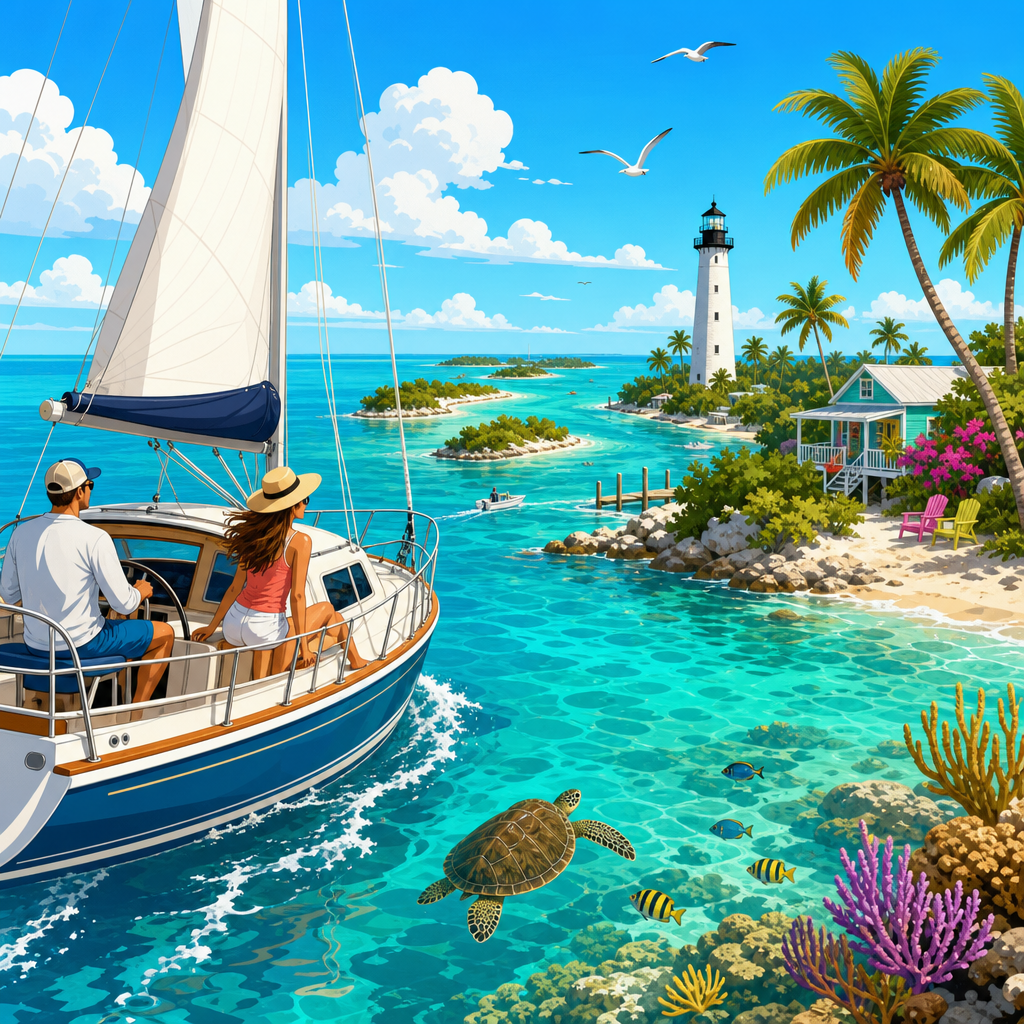
Sailing the Florida Keys is one of the most rewarding coastal cruising experiences in North America, combining protected waters, bluewater passages, lively harbors, quiet anchorages, and a chain of islands that feels purpose-built for island hopping. For boaters planning a Florida Keys sailing itinerary, the region stretches roughly 125 miles from Key Largo to Key West, linked by the Overseas Highway yet best understood from the water, where reefs, channels, state parks, backcountry basins, and weather windows shape every decision. Coastal cruising means moving steadily along a shoreline or island chain with manageable day runs, regular stops, and close attention to navigation, fuel, anchoring, and changing local conditions. Island hopping in the Keys adds another layer: each island or harbor has its own draft limitations, marina access, anchorage etiquette, and shore experience, from snorkeling at Looe Key to sunset moorings near Key West.
I have planned Keys passages on both sail and powerboats, and the same lesson always repeats: the area rewards preparation far more than bravado. Tidal current, coral heads, thin water, afternoon squalls, lobster season traffic, and winter cold fronts can change a simple leg into a stressful one if you treat the route like a casual vacation cruise. At the same time, the Florida Keys are unusually accessible for boaters who do their homework. Charts are detailed, facilities are plentiful in the main stops, and many of the best destinations sit within realistic day ranges for cruising monohulls, catamarans, trawlers, center consoles, and pocket cruisers. That balance of adventure and practicality is why the Keys remain a cornerstone destination within boating travel.
This guide serves as a hub for coastal cruising and island hopping in the Florida Keys, covering the must-visit islands, how to choose the right route, what to expect at each stop, and the operational details that matter most underway. It also answers the most common boater questions directly: when to go, where to anchor, which islands suit families or anglers, how to handle shallow approaches, and what kind of provisioning and marina support you can count on. If your goal is a weeklong sailing vacation, a longer seasonal cruise, or a stopover on a broader South Florida itinerary, understanding the character of each major island group is the key to building a safer and more enjoyable trip.
How to Plan a Florida Keys Sailing Route
The first planning decision is whether you will run the Atlantic side, the Gulf side, or alternate between them through marked channels and passes. The Atlantic side generally offers clearer water, easier access to reefs, and many of the postcard sailing conditions people expect, but it also exposes you more directly to swell and wind. The Gulf and bay side can be calmer in certain weather patterns and useful for repositioning, fishing, or avoiding ocean chop, yet depths can be less forgiving and route selection becomes more technical. For most recreational cruisers, a practical Keys sailing plan mixes both sides as conditions allow.
Weather drives everything. The best boating season for many crews runs from November through April, when humidity drops and hurricane risk is lower, but winter also brings strong cold fronts that can produce sharp wind shifts and uncomfortable seas. Late spring often offers excellent windows before summer heat and thunderstorms build. Hurricane season, officially June through November, does not make cruising impossible, but it raises insurance restrictions, marina policies, and evacuation planning requirements. NOAA marine forecasts, NWS discussions, tide predictions, and local knowledge should all inform departure times and stop selection.
Navigation standards matter more in the Keys than in many casual cruising grounds. Use updated NOAA charts, active chartplotter data from systems such as Garmin Navionics or C-MAP, and a cruising guide specific to South Florida and the Keys. Do not cut markers in unfamiliar water. Coral and hard-bottom shoals can destroy propellers, rudders, and confidence in seconds. On sailing vessels, I treat draft as a planning constant rather than a rough estimate; half a foot can determine whether an anchorage is comfortable, stressful, or inaccessible near low water.
Must-Visit Florida Keys Islands at a Glance
Each major stop in the Florida Keys serves a different type of boater. Some are best for first-night staging, some for snorkeling and diving, some for provisioning, and some for classic laid-back anchoring. The smartest itineraries recognize those roles instead of expecting every island to do everything equally well.
| Island or Area | Why Boaters Stop | Best For | Key Consideration |
|---|---|---|---|
| Key Largo | Easy northern entry point, marinas, reef access | Trip staging, diving, provisioning | Busy traffic and advance marina reservations |
| Islamorada | Protected harbors, sportfishing culture, services | Fishing, dining, mid-route stop | Shallow approaches in some basins |
| Marathon | Central location, boot key moorings, repair access | Extended stays, maintenance, resupply | Popular harbor can fill in peak season |
| Big Pine and Lower Keys | Nature focus, reefs, quieter anchorages | Snorkeling, slower cruising, wildlife | Protected areas and careful chart reading |
| Key West | Historic port, nightlife, deepwater access | Culture, marinas, trip finale | Higher costs and heavy vessel traffic |
| Dry Tortugas | Remote national park, iconic anchorage | Expedition-style extension | Weather, fuel range, and self-sufficiency |
For most crews, Key Largo, Islamorada, Marathon, and Key West form the backbone of a one-way or out-and-back Florida Keys coastal cruising route. Big Pine Key and the Lower Keys add a quieter natural segment, while Dry Tortugas is a serious add-on for well-prepared boats with the range and forecast to support it. Those distinctions help boaters avoid the common mistake of rushing the entire chain without time to enjoy the stops that best match their interests.
Key Largo: The Natural Starting Point
Key Largo is the logical northern gateway for a Florida Keys boating trip because it combines access, services, and immediate on-the-water payoff. Boats arriving from Miami, Biscayne Bay, or the Intracoastal can stage here for fuel, groceries, ice, and final systems checks before committing farther south. The area is also the doorstep to John Pennekamp Coral Reef State Park and the broader Florida Keys National Marine Sanctuary, making it a prime stop for crews prioritizing diving and snorkeling from day one.
For sailors, Key Largo is useful because it allows a final shakeout in relatively supported conditions. I have used this area to confirm autopilot behavior, inspect ground tackle after transit, and recalibrate expectations about visibility and depth reading in Keys water. Clear water can be deceptive; what looks comfortably deep may not be. Local marina staff and dive operators are often the best source for current conditions around mooring fields, channel markers, and reef access rules. If you plan to spend time offshore on the reef tract, secure moorings where available and avoid anchoring on coral or seagrass.
Shore-side, Key Largo has enough services to solve common beginning-of-trip problems quickly: forgotten spares, provisioning gaps, and minor maintenance items. That makes it more than a scenic stop; it is an operationally valuable one. Crews who start here efficiently usually cruise the rest of the chain with less friction.
Islamorada and Marathon: The Cruising Core
Islamorada sits at the center of the Upper and Middle Keys boating identity, known equally for backcountry access, flats fishing, ocean-side action, and relaxed but polished waterfront stops. For transiting cruisers, it works well as an intermediate harbor where you can pause without losing momentum. The area offers marina options, dining accessible by dinghy or short ride, and the kind of services that matter after several days aboard: laundry, pump-out access, fuel docks, and marine support. It is also one of the best places to feel how diverse Keys cruising can be, because the environment shifts quickly between open water, channels, mangrove edges, and nearshore reef zones.
Marathon, however, is the true workhorse stop for many sailors. Boot Key Harbor has long been one of the most recognized cruising harbors in the United States, and for good reason. Its mooring infrastructure, cruiser community, repair access, and central position make it ideal for longer stays, weather delays, and mid-trip regrouping. If a bilge pump fails, a sail needs stitching, or provisions are running low, Marathon is usually the easiest place in the Keys to reset. Many experienced boaters deliberately schedule extra days here because something always benefits from attention by the midpoint of a cruise.
Marathon also provides strategic flexibility. From there, crews can day trip to Sombrero Reef, reposition toward the Lower Keys, or simply wait for a better forecast before continuing. In practical cruising terms, that flexibility is invaluable. A destination that lets you safely stop, fix, resupply, and decide is often more important than one that merely photographs well.
Big Pine Key, the Lower Keys, and Key West
South of Marathon, the rhythm changes. Big Pine Key and the Lower Keys generally feel less built-up and more habitat-driven, with stronger emphasis on wildlife, protected waters, and quieter anchorages. This segment appeals to boaters who want more time swimming, paddling, fishing, or simply sitting on the hook away from denser harbor traffic. Looe Key, one of the best-known reef systems in the region, draws snorkelers and divers for good reason: healthy coral structure, abundant fish life, and comparatively easy access in suitable weather. Because these waters are environmentally sensitive, boaters should use moorings when provided, respect sanctuary rules, and keep a close eye on charts and marked routes.
Then comes Key West, which is both a cruising milestone and a fully developed port city. For many crews, arriving under sail with the town in view is the emotional high point of the trip. Key West offers deepwater approaches, broad marina choices, charter activity, waterfront bars, historic architecture, and enough shore entertainment to justify several nights. It is also one of the easiest places in the chain to transition from wilderness cruising to urban convenience. That said, it is busy, more expensive than mid-Keys stops, and crowded with tour boats, ferries, fishing traffic, and visiting yachts. Dockage should be booked early in peak season.
If your boat, crew, and forecast align, Dry Tortugas National Park is the legendary extension beyond Key West. This is not a casual add-on. The run is long, support is minimal, and self-sufficiency matters. But for prepared cruisers, anchoring near Fort Jefferson is one of the signature experiences in American boating travel.
Anchoring, Marinas, and Safe Operations in the Keys
Where should you anchor in the Florida Keys? The answer depends on wind direction, draft, protection, and whether local restrictions apply. Good anchoring in the Keys begins with bottom assessment. Sand offers the most reliable holding, while grass, hard bottom, and coral rubble can reduce confidence quickly. I favor arriving with the sun high whenever possible, because visual reading of color changes is still one of the best safety tools in shallow tropical cruising. Set the anchor carefully, confirm swing room against shallows and neighboring boats, and expect wind shifts, especially around frontal boundaries.
Mooring fields are often the better option in high-use areas because they reduce bottom damage and simplify overnight security. Marathon is the best-known example, but reef and park moorings elsewhere are equally important for protecting marine habitat. Marinas, meanwhile, are not only for comfort. In the Keys they can be critical for weather refuge, shore power in hot months, pump-out compliance, fuel management, and access to technicians. A balanced itinerary usually combines all three: anchorages for scenery, moorings for convenience and stewardship, and marinas for logistics.
Safety underway comes down to disciplined routine. Monitor VHF, especially near bridges, harbor entrances, and commercial traffic zones. Watch for manatees and enforce no-wake zones. Carry redundant navigation methods, a functioning dinghy if cruising independently, and enough water and fuel reserve to absorb delays. Heat management matters more than many visiting crews expect, and so does sun exposure. The Keys are enjoyable when handled methodically. They become difficult when skippers assume short distances mean low risk.
Building the Best Island-Hopping Itinerary
The best Florida Keys island-hopping itinerary is the one matched to your boat and priorities. A family on a charter catamaran may emphasize swim stops, easy moorings, and marina nights every few days. A couple on a 38-foot monohull might prefer longer sailing legs, simple anchorages, and one major reprovisioning stop in Marathon. Anglers may build around Islamorada and the Lower Keys, while first-time visitors often structure the trip as Key Largo to Islamorada to Marathon to Key West, allowing time for reefs, one nature-heavy stop, and a celebratory finish.
As a hub for coastal cruising and island hopping, the main takeaway is simple: do not treat the Florida Keys as one uniform destination. They are a sequence of distinct boating environments connected by culture, geography, and the practical demands of safe seamanship. Plan with current charts, conservative depth margins, realistic weather windows, and advance reservations where needed. Choose islands based on what they do best, not just what sits next on the map. When you cruise the Keys that way, the trip becomes smoother, safer, and far more memorable.
Start by mapping your entry point, deciding how many nights you can realistically spend underway, and identifying one primary goal for each stop, whether that is diving, fishing, provisioning, or simply anchoring somewhere quiet. From there, the route usually reveals itself. The Florida Keys reward boaters who travel deliberately, and few destinations repay good planning with more variety per mile. Use this guide as your starting framework, then build the island-hopping itinerary that fits your crew and cast off with confidence.
Frequently Asked Questions
What is the best route for sailing the Florida Keys from Key Largo to Key West?
The best route depends on your boat’s draft, your comfort level offshore, the season, and how much time you want to spend exploring along the way, but most cruising itineraries blend sections of the Hawk Channel on the Atlantic side with selected stops in marinas, mooring fields, and protected anchorages. A classic westbound trip begins in Key Largo or nearby Rodriguez Key, then continues toward Islamorada, Marathon, Bahia Honda, the Lower Keys, and finally Key West. Hawk Channel is the traditional cruising highway for many sailors because it offers a relatively protected inside route behind the reef tract while still allowing convenient access to many of the Keys’ best harbors and day stops. It is, however, not a route to sail casually. Depths, shoals, coral heads, aids to navigation, bridge clearances, and weather all matter, so current charts, tide awareness, and careful piloting are essential.
For boaters looking for a more relaxed island-hopping experience, breaking the trip into shorter sailing days is usually the most rewarding approach. Islamorada is a natural early stop for provisioning, dining, and exploring the Upper Keys. Marathon is often the logistical center of a Keys voyage thanks to Boot Key Harbor, which offers services, repairs, moorings, and a well-established cruising community. From there, many sailors make time for Bahia Honda, a favorite for its scenery and proximity to excellent snorkeling and beach access, before continuing through the Lower Keys toward Key West. More experienced crews may also include backcountry detours on the Gulf side, but those routes can involve shallow water and require extra care. In practical terms, the “best” route is one that respects weather windows, leaves room for lay days, and prioritizes safe daylight arrivals over ambitious mileage.
When is the best time of year to sail in the Florida Keys?
For most cruisers, the best time to sail the Florida Keys is from late fall through spring, especially roughly November through April, when humidity is lower, temperatures are more comfortable, and frontal systems often create crisp sailing conditions. This period is popular for good reason: you are more likely to enjoy manageable heat, clearer skies, and a steady stream of cruising activity, with marinas, anchorages, and waterfront towns fully engaged for the boating season. Winter and early spring can bring beautiful passages, but they also require attention to cold fronts, which can shift wind direction quickly and sometimes make exposed anchorages uncomfortable. Good itinerary planning in the Keys always includes flexibility for weather changes.
Summer can still be enjoyable, particularly for boaters comfortable with heat, afternoon thunderstorms, and a more tropical weather pattern, but it comes with bigger considerations. Hurricane season officially runs from June through November, with the highest risk generally in late summer and early fall. That does not mean summer sailing is impossible, but it does mean crews should have a clear storm plan, excellent weather resources, and the willingness to alter plans quickly. Water temperatures are warm, snorkeling conditions can be excellent, and some destinations feel less crowded, but marina reservations, hurricane preparedness, and close monitoring of forecasts become much more important. If your priority is the most broadly favorable combination of sailing weather, sightseeing, and comfort, winter and spring remain the strongest choices.
Which islands and stops are considered must-visit destinations for boaters in the Florida Keys?
Several stops consistently stand out as must-visits because they capture different sides of the Keys cruising experience. Key Largo is a logical jumping-off point and a strong introduction to the region’s reef culture, dive sites, and easy access to the upper part of the island chain. Islamorada offers a blend of casual upscale atmosphere, sportfishing heritage, good dining, and convenient access for boaters wanting a lively stop without losing the laid-back Keys feel. Marathon is often treated as a practical stop, but it is much more than a service harbor. It is central, boater-friendly, and useful for restocking, maintenance, and regrouping before continuing west. For many itineraries, it becomes the operational hub of the trip.
Bahia Honda is one of the true scenic highlights, beloved for its state park setting, clear water, and old bridge views that make it feel distinctly different from busier harbor towns. The Lower Keys reward sailors looking for a quieter pace, with fewer crowds and a greater sense of open water and natural shoreline. Then there is Key West, which is practically mandatory if your schedule allows. It combines historic seaport energy, cultural attractions, nightlife, strong marina infrastructure, and the satisfaction of reaching the western end of the chain. Depending on draft and interests, some boaters also add places such as Lignumvitae Key, Indian Key, or Dry Tortugas farther beyond Key West for a more adventurous extension. The ideal list of must-visit islands usually includes a balance of social harbors, natural parks, and at least one or two quieter anchorages that let you appreciate the Keys after sunset, when the crowds disappear and the cruising experience feels most personal.
What should boaters know about navigation, anchoring, and reef protection in the Florida Keys?
The Florida Keys reward attentive, disciplined seamanship. Navigation here is not inherently difficult for prepared boaters, but it is unforgiving of carelessness because the region is defined by shallow banks, narrow cuts, marked channels, coral ecosystems, and rapidly changing local conditions. Accurate, up-to-date charts are essential, and they should be used alongside visual piloting, depth sounders, tide awareness, and prudent speed. Entering unfamiliar anchorages or channels in good light is one of the simplest and most valuable habits you can adopt. Water color changes can reveal shoals and grass flats, but glare, cloud cover, and sun angle can reduce visibility quickly, so planning arrivals for midday or early afternoon often makes navigation easier.
Anchoring also requires a conservation mindset. Much of the Keys lies near sensitive seagrass beds and coral habitat, and boaters are expected to avoid damaging either one. Never anchor on coral, and avoid tearing through shallow grass flats with prop wash. Use established mooring fields where available, especially in high-use or environmentally sensitive areas. In places where anchoring is permitted, choose sandy patches when possible and confirm your swing radius carefully, since depths and holding can vary. It is also important to understand local regulations in protected areas, marine sanctuaries, and state parks, where access, fishing, waste disposal, and overnight stays may be limited or managed. Responsible boating in the Keys is not just about protecting the environment in theory; it directly preserves the clear water, reef life, and anchoring beauty that make the region worth sailing in the first place.
How many days should you plan for a Florida Keys sailing itinerary, and what kind of experience can you expect?
A good Florida Keys sailing itinerary can work in as little as five to seven days, but that time frame usually feels more like a sampler than a full experience. If your goal is simply to move from the Upper Keys to Key West with a handful of meaningful stops, one week can be enough with careful planning and favorable weather. That said, 10 to 14 days is a much more satisfying window for most boaters because it allows time to enjoy both the passages and the destinations without treating every stop as an overnight checkpoint. The Keys are best appreciated at a pace that leaves room for weather delays, snorkeling days, lazy harbor mornings, and unplanned discoveries such as a favorite waterfront restaurant, a quiet sunset anchorage, or a backcountry excursion.
In terms of experience, expect variety rather than one single cruising style. Some days will feel like easy coastal hops in relatively protected water; others may involve more exposed sailing, tide-conscious timing, or concentration in busy channels and harbor entrances. You can move from reef-side turquoise water to practical town marinas, from social mooring fields filled with cruising boats to surprisingly peaceful natural settings in a short distance. That contrast is part of the appeal. The Florida Keys are not just a line of islands to tick off on a chart. They offer a layered cruising ground where navigation, scenery, marine life, waterfront culture, and weather all shape the journey. If you build in enough time to slow down, the trip becomes less about reaching Key West and more about enjoying the entire chain as one of the most distinctive sailing destinations in the United States.