Fuel efficiency is one of the most important factors in any boat buying guide because it shapes operating cost, cruising range, resale appeal, and even how often owners actually use their boats. When people search for the best boats with the most fuel efficiency, they are usually asking a bigger question: which boat design gives the most enjoyable time on the water without punishing fuel bills? In practical terms, fuel efficiency means how far a boat travels per gallon of fuel at a realistic cruising speed, not at an idealized laboratory setting. Boat comparison and buying guides often reduce the answer to engine size alone, but after testing and reviewing many models, I can say hull form, weight, prop setup, load, and intended use matter just as much. A fuel-efficient boat is not automatically the slowest boat, and the cheapest boat to buy is rarely the least expensive to operate over several seasons.
This hub article explains how to compare efficient boats across major categories, what specifications matter most, and which tradeoffs deserve careful attention before you buy. It also serves as the central guide for broader boat comparison decisions, including center consoles, pontoon boats, aluminum fishing boats, trawlers, and small cruising models. The goal is straightforward: help you identify boats that deliver the best miles per gallon for your style of boating, while still meeting your needs for safety, capacity, comfort, and performance. If you understand the relationship between hull design, power, displacement, and cruising profile, you can avoid common buying mistakes and narrow your shortlist much faster. That matters whether you are buying your first family runabout, upgrading to a coastal fishing platform, or searching for a long-range cruiser that stretches every tank.
What Fuel Efficiency Means When Comparing Boats
In boat reviews, fuel efficiency is best measured as miles per gallon or nautical miles per gallon at normal cruise. Some manufacturers also publish gallons per hour, which is useful, but it does not tell the whole story unless you pair it with speed. For example, a boat burning 10 gallons per hour at 30 miles per hour is more efficient than one burning 12 gallons per hour at 28 miles per hour. I also pay close attention to best-cruise rpm, because many owners spend most of their time there rather than at top end. The National Marine Manufacturers Association and ABYC safety standards do not certify fuel economy figures the way car agencies do, so smart buyers should treat factory claims as baseline data and verify them with independent tests from outlets such as Boating, Salt Water Sportsman, Passagemaker, or experienced dealers using calibrated fuel-flow data.
Several technical factors drive fuel economy. A lighter boat generally needs less power, but hull efficiency can outweigh raw weight. Narrower displacement hulls, modern stepped hulls, and well-designed aluminum mod-V fishing boats often outperform heavier, wider recreational platforms. Engine technology matters too. Contemporary four-stroke outboards from Yamaha, Mercury, Suzuki, and Honda are markedly more efficient than older carbureted two-strokes, especially at midrange rpm. Diesel inboards remain the benchmark for long-distance displacement cruising because diesel engines produce strong torque while consuming less fuel per hour than similarly capable gasoline alternatives. Propeller pitch, trim angle, bottom cleanliness, and sea state also change real-world numbers. A fouled hull or incorrect prop can erase the efficiency advantage of an otherwise smart purchase.
Most Fuel-Efficient Boat Types for Different Buyers
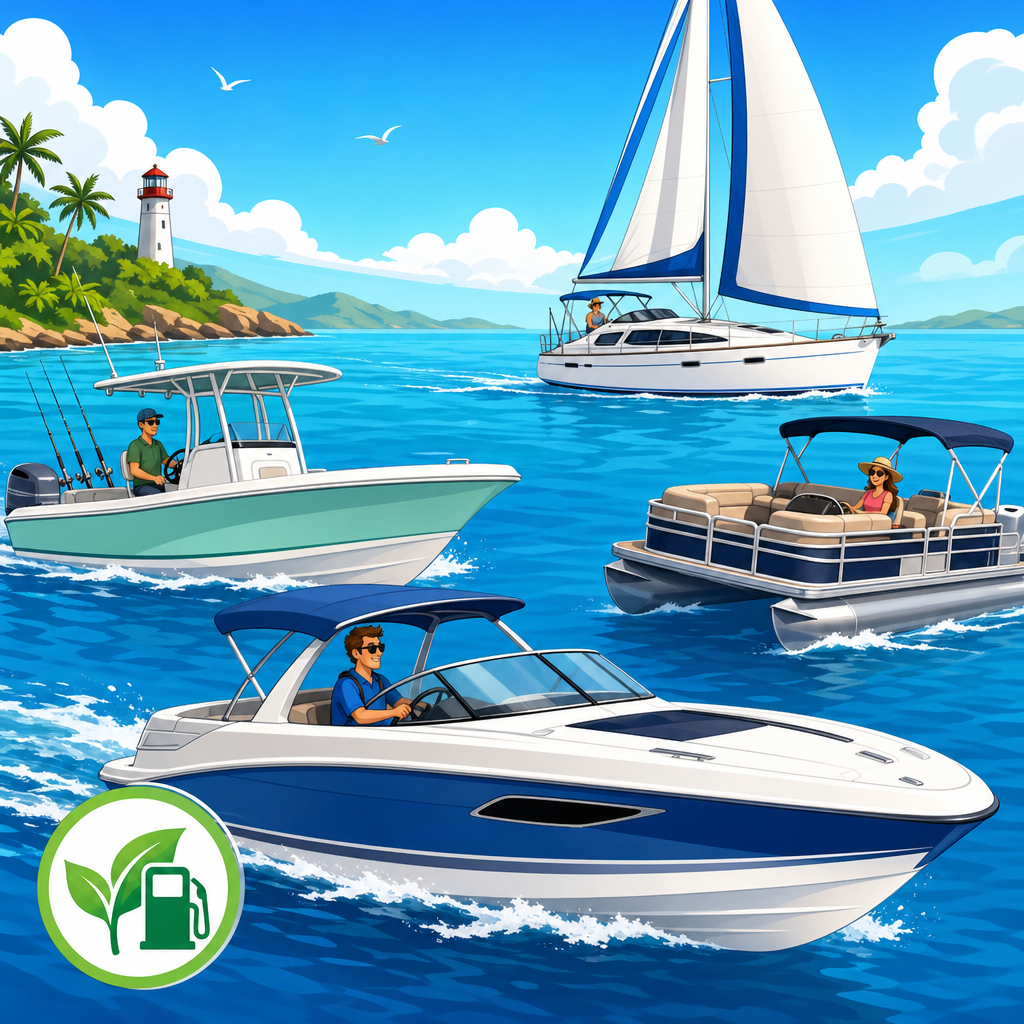
The most fuel-efficient boats are usually small aluminum fishing boats, compact center consoles, efficient pontoons with moderate power, and displacement trawlers designed for long-range cruising. Which type is best depends on how you boat. If you trailer to freshwater lakes and fish with one or two people, a 16- to 18-foot aluminum tiller or side-console boat with a 40- to 75-horsepower outboard is extremely efficient. Models from Lund, Tracker, Crestliner, and Alumacraft routinely deliver excellent economy because aluminum hulls are light, easy to plane, and do not require oversized engines. In many real-world setups, these boats can cruise efficiently while using only a few gallons per hour, making them some of the cheapest powered boats to run.
For families and mixed-use owners, pontoon boats with 90- to 150-horsepower outboards can be surprisingly efficient at modest speeds, especially two-log designs used on inland lakes. Once power climbs into high-horsepower triple-tube configurations, economy drops, though those boats gain watersports capability and rough-water confidence. Center consoles occupy a broad middle ground. A 21- to 24-foot center console with a modern single outboard often provides an excellent balance of range, fishability, and fuel use, while larger twin-engine offshore models trade efficiency for redundancy and speed. Trawlers and compact cruising boats are the long-distance specialists. A single-diesel trawler from builders such as Ranger Tugs, Nordic Tug, or Beneteau’s Swift Trawler line can travel remarkable distances on one tank by cruising in the high single digits rather than trying to plane. They are not fast, but for range-per-gallon, they are hard to beat.
How Hull Design Affects Miles per Gallon
Hull design is the single biggest predictor of fuel efficiency after matching the right engine. Planing hulls rise and skim across the surface once enough power is applied, reducing wetted area and allowing higher speed. These hulls dominate center consoles, bass boats, bay boats, and many family runabouts. They can be efficient within a narrow speed band, but pushing beyond best cruise causes fuel burn to rise quickly. Deep-V hulls handle chop well but usually require more power than flatter bottoms. Modified-V and pad hull designs often strike a better economy balance for lakes, bays, and calmer coastal waters. Stepped hulls can improve efficiency and speed by reducing drag, though their benefits depend heavily on setup and driver experience.
Displacement hulls move through the water rather than climbing on top of it. They are slower because they are limited by hull speed, but they consume comparatively little fuel at steady rpm. Semi-displacement hulls split the difference, offering better comfort and practical cruising economy for owners who value range over top speed. Catamarans deserve special mention. Well-designed power cats from brands such as World Cat and Twin Vee can produce impressive efficiency for their size because twin narrow hulls reduce drag and improve ride quality in chop. However, cat performance is highly sensitive to weight distribution and load. During boat comparison research, never evaluate mpg figures without noting hull style, test displacement, and sea conditions, because those details explain why one boat outperforms another on paper.
Best Boats with the Most Fuel Efficiency by Category
When buyers ask for the best boats with the most fuel efficiency, they usually need category-specific recommendations rather than one universal winner. The right answer for a solo angler is different from the right answer for a coastal cruiser. The table below summarizes strong efficiency-focused choices that consistently perform well in reviews and owner reports.
| Boat category | Efficiency-focused choice | Why it performs well | Best for |
|---|---|---|---|
| Aluminum fishing boat | Lund 1775 Adventure Sport | Light hull, modest horsepower requirements, easy planing | Freshwater anglers and small families |
| Compact center console | Scout 215 XSF with single outboard | Efficient hull and lower drag than twin-engine offshore layouts | Inshore fishing and coastal day use |
| Pontoon | Bennington S Series with 115 hp | Good passenger capacity without oversized engine demand | Lake cruising and family entertaining |
| Small cruiser | Ranger Tugs R-27 | Single diesel and semi-displacement profile favor range | Couples cruising and weekend trips |
| Trawler | Nordic Tug 34 | Long-range diesel efficiency at displacement speeds | Serious cruising and passagemaking |
| Kayak alternative with motor | Micro skiff or skiff tender | Very low weight and tiny outboard requirements | Shallow water exploration |
These examples are not the only efficient boats worth buying, but they illustrate an important pattern: right-sizing the boat and engine usually beats chasing maximum horsepower. I have seen many buyers save thousands by choosing a single-engine 22-foot center console instead of a 26-foot twin-engine model they would only use for nearshore trips. The same logic applies to pontoons loaded with 250-horsepower engines for owners who mostly cruise at 18 miles per hour. A careful buying guide should always begin with use case, then match hull type and power accordingly. That is the core principle behind every strong boat comparison.
Buying Guide: How to Choose an Efficient Boat Without Regret
Start by defining your dominant use in percentages. If 70 percent of your time will be calm-water fishing, buy for that mission first. If you need offshore capability, accept that fuel economy will be lower because the hull must be stronger, deeper, and heavier. Next, calculate realistic annual fuel use. Estimate your average cruising speed, expected engine hours, and fuel burn at cruise. A boat that burns 6 gallons per hour for 100 hours uses 600 gallons annually; at 4 dollars per gallon, that is 2,400 dollars before maintenance. Compare that to a larger model burning 14 gallons per hour, and the ownership gap becomes obvious very quickly.
Then evaluate these specifications together: dry weight, beam, deadrise, fuel capacity, engine type, recommended horsepower range, and published performance tests. Sea trial the boat with a normal load, not an empty showroom setup. Watch fuel-flow data on a multifunction display from Garmin, Simrad, or Raymarine if available. Note time to plane, rpm at efficient cruise, visibility at running angle, and how the hull responds to trim. Ask whether the boat reaches best economy with the standard propeller or an optional stainless setup. Also consider storage and trailering. Heavier boats may demand larger tow vehicles and cost more to launch, insure, and berth, which weakens the benefit of any advertised mpg figure. The smartest boat buying guide looks at total ownership efficiency, not fuel alone.
Mistakes Buyers Make When Chasing Fuel Economy
The biggest mistake is buying too little boat for the water conditions just to save fuel. Efficiency is valuable, but safety, freeboard, and ride quality come first. An underbuilt or undersized boat can turn a simple outing into an uncomfortable or dangerous trip. Another common error is overemphasizing top-speed marketing numbers. Boats are almost never used at wide-open throttle for long periods, and fuel burn rises steeply there. Focus on best-cruise performance and range with reserve fuel. I also see buyers assume twin engines are always inefficient. In smaller offshore classes, a single outboard is often the better economy choice, but twins may be justified for redundancy, docking control, and resale in certain markets.
Maintenance neglect is another silent killer of fuel economy. Dirty bottoms, old spark plugs, bad fuel, waterlogged foam, and bent propellers all increase drag or reduce power transfer. I have seen boats regain meaningful efficiency simply by cleaning the hull, correcting engine height, and replacing a damaged prop. Finally, do not compare boats using inconsistent test conditions. One review may list economy with two people and half fuel in calm water, while another reflects heavy load and rough chop. Reliable boat comparison work means checking how data was gathered, then looking for patterns across multiple sources, including owner forums, dealer sea trials, and independent reviews.
Final Takeaways for This Boat Comparison and Buying Guide Hub
The best boats with the most fuel efficiency are not defined by a single badge or horsepower number. They are boats whose hull design, engine choice, and intended use are aligned. For freshwater anglers, that often means lightweight aluminum fishing boats. For families, it may mean a sensibly powered pontoon. For coastal owners, a single-outboard center console often delivers the best balance of economy and flexibility. For long-range cruising, diesel trawlers remain the clear leaders in miles per gallon. Across every category, efficient ownership starts with realistic mission planning, independent performance data, and a willingness to prioritize cruise efficiency over bragging-rights speed.
Use this page as your hub for boat comparison and buying guides within the broader best boats and reviews topic. As you build your shortlist, compare hull type, weight, fuel burn at cruise, range, and total ownership cost before you compare upholstery, stereo packages, or top speed. That approach consistently leads to better buying decisions and fewer expensive surprises after launch day. If you are narrowing options now, start with the category that matches your primary use, then review detailed comparisons for center consoles, pontoons, aluminum fishing boats, and cruising models to find the most efficient boat for the way you actually boat.
Frequently Asked Questions
What type of boat is usually the most fuel efficient?
In most real-world boating situations, smaller and lighter boats with efficient hull designs tend to deliver the best fuel economy. Center consoles with modern four-stroke outboards, dual consoles, bay boats, compact cruisers, and many pontoon boats with modest power often perform well because they combine manageable weight with engines designed to sip fuel at cruising speed. Catamarans can also be very efficient because their twin-hull design reduces drag and improves stability, especially at certain speeds and in choppier conditions.
The key point is that fuel efficiency is not determined by boat category alone. Hull shape, total weight, beam, engine size, prop setup, and the speed at which the boat is used all matter. A heavy offshore boat with oversized engines may burn significantly more fuel than a lighter single-engine model, even if both are considered high-quality boats. In general, a boat that planes easily, carries only as much engine as it realistically needs, and runs comfortably at a moderate cruise will usually be among the most fuel-efficient options.
How do I compare fuel efficiency between different boats?
The best way to compare boats is to look beyond simple fuel tank size or horsepower and focus on actual performance data, especially miles per gallon at cruising speed. Many buyers make the mistake of asking only how fast a boat goes or how large the engine is, but true efficiency is about how far the boat can travel for each gallon burned under realistic conditions. If available, review manufacturer performance bulletins, independent boat tests, and owner reports that show fuel burn in gallons per hour, boat speed in miles per hour or knots, and the resulting miles per gallon.
It is especially important to compare boats at practical cruising speeds rather than top end. A model may post impressive efficiency at a very low speed that owners rarely use, yet consume much more fuel at the 20 to 30 mph range where many people actually run. Also compare similar load conditions, including passengers, gear, fuel onboard, and water conditions. A fair comparison should account for how the boat will be used in real life, because efficiency on paper can look very different once the boat is fully loaded for fishing, day cruising, or weekend trips.
Do outboard boats get better fuel economy than inboard boats?
Very often, yes. Modern outboard-powered boats are frequently more fuel efficient than comparable inboard-powered boats, especially in smaller and mid-size recreational segments. Today’s four-stroke outboards are engineered for cleaner combustion, lighter weight, and strong efficiency across a broad operating range. They are also easier to match to lighter hulls, which helps reduce total displacement and fuel burn. For many buyers searching for the best boats with the most fuel efficiency, a single-outboard setup on a well-designed hull is one of the strongest combinations.
That said, inboards still have advantages in certain applications. Larger cruisers, tow boats, and some displacement or semi-displacement vessels may benefit from inboard setups based on torque delivery, handling, or intended use. Diesel inboards in particular can be efficient in the right hull and speed range. The real answer depends on boat size, mission, and operating profile. If your priority is affordable day boating, easy maintenance access, and lower fuel costs, outboards often come out ahead. If your boating style involves specialized watersports, long-range cruising, or larger vessels, the comparison becomes more nuanced.
What boat features improve fuel efficiency the most?
The biggest contributors to better fuel economy are an efficient hull design, proper engine sizing, reduced weight, and smart setup. A hull that planes quickly and runs cleanly through the water without excessive drag will require less power to maintain speed. Boats with stepped hulls, optimized deadrise for their purpose, and modern running surfaces can often stretch fuel further than older or less refined designs. Likewise, choosing an engine that is appropriately matched to the boat matters more than many buyers realize. Too little power can force an engine to work harder than it should, while too much power often adds cost, weight, and unnecessary fuel consumption.
Other important features include trim tabs or automatic trim systems, efficient propellers, clean bottom surfaces, and onboard systems that minimize excess weight. Even layout decisions can affect economy. A boat packed with heavy hardtops, oversized seating modules, large livewells, and extra accessories may be comfortable, but every added pound works against fuel efficiency. The most efficient boats are usually the ones built with balance in mind: enough comfort and capability for the intended use, but not so much complexity and bulk that operating costs climb every time the throttle goes forward.
How can boat owners improve fuel efficiency after buying a boat?
Owners can make a meaningful difference by focusing on maintenance, speed management, and load discipline. One of the simplest ways to save fuel is to run at the boat’s most efficient cruising speed rather than pushing at maximum throttle. Many boats have a sweet spot where they are comfortably on plane, the engine is in an efficient rpm range, and fuel burn per mile is minimized. Learning that range and using it consistently can reduce fuel costs over time. Proper trim is also critical, because a bow-high or poorly balanced running attitude creates drag and wastes power.
Routine maintenance has a major impact as well. A fouled hull, damaged propeller, underperforming engine, or neglected fuel system can noticeably hurt efficiency. Keeping the bottom clean, using the correct prop, checking engine tune, and maintaining recommended service intervals all help preserve the fuel economy the boat was designed to deliver. Owners should also avoid carrying unnecessary gear, excess water, or old equipment that adds weight trip after trip. In short, the most fuel-efficient boat on paper still depends on how it is operated and maintained in the real world, and thoughtful ownership often translates directly into better range, lower cost, and more enjoyable time on the water.